
In my extensive experience as a mechanical engineer specializing in gear design and manufacturing, I have consistently observed that the performance and longevity of planetary gear systems hinge critically on the judicious selection of materials and the precise application of heat treatment processes. Planetary gear sets, such as those in the common NGW-type configuration, are ubiquitous in applications ranging from automotive transmissions to industrial machinery, where they must transmit substantial power, adjust speeds, and endure severe loading conditions. The gears within these systems—namely the sun gear, planet gears, and ring gear—are subjected to complex stress states including high cyclic bending stress, contact pressure, and impact loads during meshing. Consequently, the material for each component must exhibit a synergistic combination of high surface hardness for wear resistance and contact fatigue strength, coupled with a tough, ductile core to withstand bending and shock loads. Furthermore, the heat treatment applied must be meticulously controlled to achieve these desired properties while minimizing dimensional distortion and, crucially, avoiding various heat treatment defects that can compromise gear integrity.
The core philosophy I advocate is that material selection and heat treatment are inseparable decisions. One cannot be optimized without considering the other. In this comprehensive discussion, I will delve into the rationale behind choosing specific alloy steels for different gear roles, elaborate on the corresponding heat treatment techniques—such as quenching and tempering, induction hardening, and case carburizing—and underscore the paramount importance of hardness matching between mating gear pairs. Throughout, I will frequently highlight the types, causes, and preventative measures for heat treatment defects, as their occurrence is a primary cause of premature gear failure in service.
Fundamental Requirements for Gear Materials
Before addressing specific materials, it is essential to establish the fundamental property requirements. A gear tooth is essentially a cantilever beam subjected to a cyclic load at its tip. The failure modes primarily include tooth bending fatigue (root cracking) and surface failure modes such as pitting (contact fatigue), scuffing, and wear. Therefore, the ideal gear material must possess:
- High Bending Fatigue Strength: To resist crack initiation and propagation at the tooth root. This is largely governed by the core microstructure and strength.
- High Contact Fatigue Strength: To resist subsurface-originated pitting on the tooth flanks. This is primarily a function of surface hardness and the residual stress profile.
- High Surface Hardness and Wear Resistance: To minimize abrasive wear and adhesive wear (scuffing) under high-pressure sliding-rolling contact.
- Sufficient Core Toughness: To absorb impact loads and provide support for the hardened case, preventing brittle fracture.
- Good Hardenability: The ability to form a martensitic structure to a sufficient depth upon quenching, which is vital for achieving the required core strength and case depth, especially in larger sections. Inadequate hardenability is a root cause of several heat treatment defects like soft spots.
- Minimal Distortion Tendency: Dimensional changes during heat treatment must be predictable and minimal to maintain gear accuracy without excessive finishing costs.
The pursuit of these properties inevitably leads us to alloy steels and controlled thermal processing. The most common heat treatment defects—such as excessive distortion, cracking, insufficient case depth, soft spots, retained austenite, oxidation, and decarburization—directly undermine these very properties. For instance, grinding cracks originating from improper tempering after hardening can drastically reduce bending fatigue strength.
Rational Material Selection for Planetary Gear Components
The loading patterns differ significantly among the sun gear, planet gears, and ring gear in a planetary set. This asymmetry justifies a differentiated material strategy. The following table summarizes my recommended approach based on load-bearing criticality and functional role.
| Gear Component | Load Characteristics & Criticality | Primary Recommended Material | Alternative Materials | Key Rationale |
|---|---|---|---|---|
| Sun Gear | Meshes with multiple planets simultaneously; highest number of load cycles per revolution; critical for system integrity. | 20CrMnTi (AISI 8620 equivalent or similar case-hardening steel) | 20CrMo, 20CrNiMo, 18CrNiMo7-6 | Requires excellent core toughness and a deep, hard case. High-hardenability alloy steel ensures performance under high cyclic contact and bending stresses. Proper carburizing is essential to avoid heat treatment defects like internal oxidation or non-martensitic surface layers. |
| Planet Gears | Meshes with both sun and ring gears; experiences bidirectional bending stresses; also high-cycle component. | 20CrMnTi (or equivalent) | 20CrMo, 20CrNiMo | Similar stress state to sun gear demands similar high-performance material. Consistent case depth control across all planets is vital to prevent uneven load sharing and premature failure—a potential consequence of batch-level heat treatment defects. |
| Ring Gear (Internal Gear) | Generally has larger size and greater structural redundancy; tooth loads are shared over a larger area. | 42CrMo (AISI 4140 equivalent, quenched and tempered) | 40Cr, 35CrMo, For large rings: nodular cast iron (e.g., QT700-2) | High core strength and toughness from quenching and tempering are often sufficient. Can be surface-hardened (induction or nitriding) for higher durability. Using a lower-cost material here is economically sound. However, improper tempering can lead to temper embrittlement, a severe heat treatment defect. |
From Table 1, it is clear that case-hardening steels like 20CrMnTi are the workhorses for the highly stressed sun and planet gears. The choice of 42CrMo for the ring gear reflects a balance between performance and cost. It is imperative that the heat treatment processes for these distinct materials are tailored to their chemistry and service demands to avert specific heat treatment defects.
In-Depth Analysis of Heat Treatment Processes and Associated Defects
Selecting the right material is only half the battle. The thermal and thermochemical processes that follow define the final microstructure and properties. I will now dissect the common treatments for the materials listed above, with constant vigilance toward potential heat treatment defects.
1. Quenching and Tempering (Q&T) for Medium-Carbon Alloy Steels (e.g., 42CrMo, 40Cr)
This process is typically applied to ring gears or gears requiring high strength and toughness without an extremely hard surface. The goal is to produce a tempered martensite or bainite microstructure throughout the section.
Process Steps:
- Austenitizing: Heating to a temperature above the Ac3 line to form a homogeneous austenite phase. For 42CrMo, this is typically in the range of $$T_{\text{Austenitize}} \approx 840 – 860\,^\circ\text{C}$$. Precise temperature control is vital; overheating can cause coarse austenite grains, leading to poor toughness and quench cracking—a catastrophic heat treatment defect.
- Quenching: Rapid cooling in oil (or polymer quenchant) to transform austenite to martensite. The cooling rate must exceed the critical cooling rate for the steel’s section size. Inadequate quenching speed results in the formation of soft pearlite or bainite instead of martensite, a defect manifesting as low hardness and strength.
- Tempering: Reheating the quenched gear to a temperature below the Ac1 (e.g., $$T_{\text{Temper}} = 550 – 650\,^\circ\text{C}$$ for 42CrMo) to relieve internal stresses, improve toughness, and achieve the desired hardness/strength balance. The final hardness often targets 280-350 HB. The relationship between tempering temperature (T, in Kelvin) and hardness (HV) can be approximated by empirical formulas like the Hollomon-Jaffe parameter: $$P = T(C + \log t)$$ where t is time, and C is a constant. Improper tempering, especially slow cooling through the 375-575°C range for some alloy steels, can induce temper embrittlement, a classic heat treatment defect that drastically lowers impact toughness.
Common Defects in Q&T:
- Quench Cracking: Caused by excessive thermal and transformational stresses during quenching. Factors include sharp geometry changes, too high an austenitizing temperature, or unsuitable quenchant.
- Insufficient Hardness: Due to under-austenitizing, slow quenching (poor agitation, wrong quenchant), or excessive tempering temperature.
- Distortion and Warpage: Uneven heating or cooling, improper fixturing during treatment.
- Temper Embrittlement: As mentioned, a time-temperature-dependent phenomenon in some alloy steels.
2. Induction (High-Frequency) Hardening for Surface Hardening
This is often used for ring gears made of 42CrMo or 40Cr where only the tooth flanks and roots need to be hardened. It involves localized heating via electromagnetic induction followed by rapid quenching.
Process Parameters: For a 42CrMo gear requiring a surface hardness of 50-55 HRC, the typical induction heating temperature is $$T_{\text{Induction}} \approx 880 – 920\,^\circ\text{C}$$, followed by immediate spray quenching with a polymer solution. A subsequent low-temperature tempering at 150-200°C is essential to relieve quenching stresses and reduce brittleness, thereby mitigating the risk of grinding cracks—a secondary heat treatment defect that can appear during final machining.
The hardened case depth (δ) is a function of frequency (f), material properties, and heating time. A simplified estimation for the current penetration depth (skin depth) is given by: $$\delta \approx \frac{1}{\sqrt{\pi f \mu \sigma}}$$ where μ is permeability and σ is electrical conductivity. Controlling this depth precisely is key; shallow cases lead to spalling, while excessively deep hardening can cause unnecessary distortion.
Common Defects in Induction Hardening:
- Overheating/Burning: Localized melting or grain growth due to excessive power density.
- Insufficient Hardness or Soft Spots: From inadequate heating temperature, poor coupling, or insufficient quench.
- Cracking: Often at tooth roots due to high stress concentration and rapid quenching. Proper tempering is the primary preventative measure.
- Inconsistent Case Pattern: Due to improper coil design or part positioning, leading to uneven load capacity.
Every one of these heat treatment defects can be traced back to a deviation in process parameters or material condition.
3. Case Carburizing and Hardening for High-Performance Gears (e.g., 20CrMnTi)
This is the most critical process for sun and planet gears. It involves enriching the surface layer with carbon (typically to 0.7-0.9% C) at high temperature, followed by quenching to produce a hard, wear-resistant martensitic case over a tough, low-carbon martensitic or bainitic core.
Process Stages:
- Pre-heat Treatment (Normalizing/Forging Heat): The gear forgings are often normalized (heated to $$T_{\text{Normalize}} \approx 920-950\,^\circ\text{C}$$ and air-cooled) to refine the grain structure and improve machinability. Utilizing the forging heat for normalization can be efficient but requires precise control to avoid abnormal grain growth—a latent heat treatment defect that only manifests later.
- Carburizing: The gears are packed in a carbon-rich atmosphere (gas carburizing is most common) at temperatures between $$T_{\text{Carburize}} = 900 – 930\,^\circ\text{C}$$. The carbon diffusion follows Fick’s second law. The case depth (d) as a function of time (t) and temperature can be estimated by: $$d \approx k \sqrt{t}$$ where k is a temperature-dependent diffusion constant. The target case depth is selected based on the module (m) and loading, as shown in Table 2. An optimal surface carbon concentration is around 0.8%; exceeding 1.0% can lead to excessive retained austenite or brittle carbides, both detrimental heat treatment defects.
| Load Severity | Typical Application | Recommended Case Depth (as fraction of module, m) | Approximate Absolute Depth (mm) |
|---|---|---|---|
| Light | Instruments, low-power drives | 0.10 – 0.15 m | 0.3 – 0.6 |
| Medium | General industrial gears, automotive auxiliaries | 0.15 – 0.20 m | 0.6 – 1.0 |
| Heavy | Vehicle transmissions, heavy machinery | 0.20 – 0.30 m | 1.0 – 1.5 |
| Very Heavy | Mining, aerospace, extreme duty | > 0.30 m | > 1.5 |
- Quenching: After carburizing, gears are either directly quenched from the carburizing temperature (direct quenching) or slowly cooled, reheated, and then quenched (reheating quenching). For 20CrMnTi, direct quenching from around $$850\,^\circ\text{C}$$ is common due to its fine grain stability. The quench transforms the high-carbon case to high-hardness martensite (60-64 HRC) and the core to lower-carbon martensite/bainite (35-45 HRC).
- Low-Temperature Tempering: Mandatory at $$T_{\text{Temper}} = 150 – 200\,^\circ\text{C}$$ to relieve quenching stresses, transform some retained austenite, and improve fracture resistance.
Common and Critical Defects in Carburizing: This process is particularly prone to a spectrum of heat treatment defects that must be rigorously controlled.
- Excessive Retained Austenite: A soft, metastable phase that reduces hardness, wear resistance, and can lead to dimensional instability later. Caused by too high a surface carbon content or too low a quench temperature. It can be remedied by deep freezing or high-temperature tempering, but prevention is key.
- Grain Boundary Oxidation & Internal Oxidation: A subsurface defect where alloying elements (Si, Mn, Cr) oxidize, forming soft, non-martensitic zones that are potent initiators for contact fatigue. It is a major heat treatment defect in gas carburizing and is mitigated by using controlled atmospheres with low oxygen potential.
- Carbide Networking: Formation of continuous brittle carbide films along prior austenite grain boundaries at the surface if carbon concentration is too high (>1.0%), leading to spalling and brittle fracture.
- Insufficient Case Depth: Results from low carburizing temperature, short time, or poor atmosphere carbon potential. Leads to early pitting failure.
- Excessive Distortion: The thermal gradients during heating, carburizing, and quenching cause complex shape changes. It is managed through symmetrical design, stress-relief annealing prior to treatment, and optimized quenching (e.g., high-pressure gas quenching).
- Soft Spots (or Soft Core): Inadequate core hardenability can lead to non-martensitic transformation products (ferrite, pearlite) in the core or sub-case region, severely reducing bending strength. This is a fundamental material-related heat treatment defect.
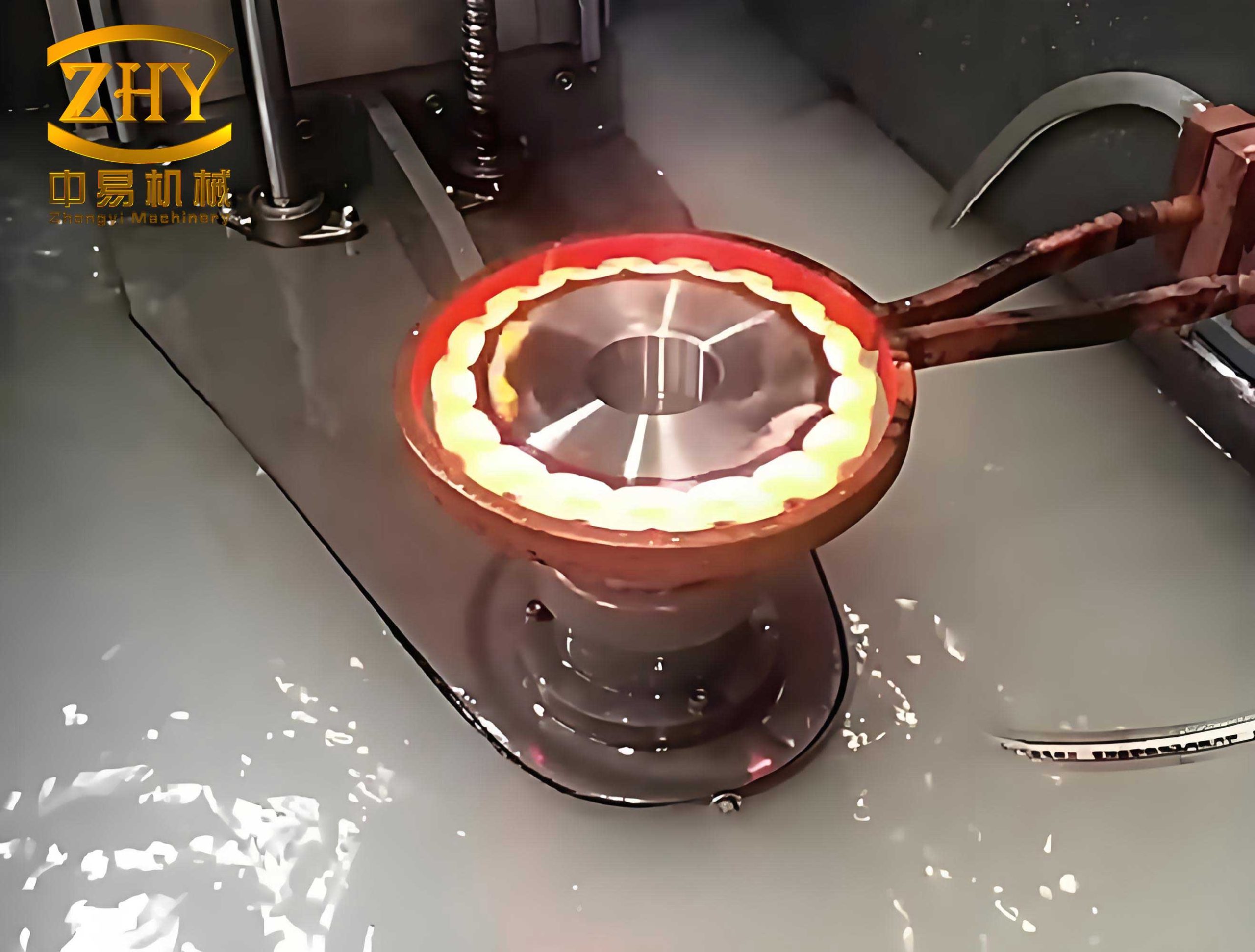
The image above provides a visual reference for some typical manifestations of heat treatment defects, such as cracks, distortion, and microstructural anomalies. In practice, preventing these defects requires a holistic approach encompassing material cleanliness, precise furnace atmosphere control, validated quenching systems, and comprehensive process monitoring.
Hardness Matching Between Mating Gear Pairs
Even with individually well-treated gears, the system performance depends on their interaction. A key design principle I always enforce is maintaining an optimal hardness difference between mating tooth surfaces. For a metal-to-metal gear pair, a significant hardness differential is beneficial. A common rule is to have the pinion (or smaller gear, like the sun gear) harder than the larger mating gear (planet or ring) by 2-5 HRC points, or ideally by a margin of 30-50 HB. This can be expressed as a condition: $$\Delta H = H_{1} – H_{2} \geq 30\,\text{to}\,50\,\text{HB}$$ where \(H_1\) is the hardness of the harder gear (usually sun/planet) and \(H_2\) is the hardness of the softer gear (ring or its mate).
Rationale and Effect: The harder pinion teeth work-harden the softer gear teeth during initial run-in, improving the surface fatigue limit of the softer gear. Studies indicate this can increase the allowable contact stress for the softer gear by 10-20%. Furthermore, it helps in distributing wear more evenly. However, the surface finish of the harder gear must be superior (lower roughness) to prevent abrasive wear on the softer member.
Recommended Hardness Combinations: Based on the material selections discussed, a typical setup for an NGW planetary set would be:
- Sun Gear & Planet Gears (20CrMnTi, carburized): Surface hardness: 58-62 HRC (approx. 650-700 HV). Core hardness: 35-45 HRC.
- Ring Gear (42CrMo, induction hardened or Q&T): If induction hardened: surface hardness 50-55 HRC. If quenched and tempered: bulk hardness 280-320 HB (approx. 30-34 HRC).
This creates the desired hardness gradient. Achieving this precise matching requires meticulous control over the final tempering steps to hit target hardness values. Variations in final hardness are themselves a category of heat treatment defects that can lead to noise, vibration, and uneven load distribution.
Advanced Considerations and Mitigation of Heat Treatment Defects
To push the performance envelope and reliability further, several advanced practices must be integrated into the manufacturing philosophy. Each is aimed at suppressing specific heat treatment defects.
Process Simulation and Distortion Prediction
Finite Element Analysis (FEA) software can now simulate the thermal, phase transformation, and stress evolution during heating, carburizing, quenching, and tempering. By inputting material Transformation-Induced Plasticity (TRIP) data and heat transfer coefficients, one can predict distortion patterns and optimize fixturing or process sequences to minimize it. This proactive approach is far superior to correcting distortion post-treatment, which is often impossible.
Controlled Atmosphere and Low-Pressure Carburizing (LPC)
Traditional gas carburizing is prone to intergranular oxidation. LPC, performed in a vacuum furnace with precise pulses of hydrocarbon gas, virtually eliminates this defect. It offers excellent case uniformity, reproducibility, and environmental benefits. The absence of oxygen prevents the formation of non-martensitic surface layers, directly addressing one of the most pernicious heat treatment defects in high-performance gears.
Alternative and Complementary Surface Treatments
While carburizing is dominant, other processes offer advantages in specific scenarios:
- Nitriding: A low-temperature (500-580°C) process that introduces nitrogen into the surface, forming very hard nitrides without a phase transformation. It induces minimal distortion and excellent wear/fatigue resistance but creates a shallower case. It is suitable for finished gears or those with complex shapes. Defects include a brittle “white layer” which must be controlled or removed.
- Cryogenic Treatment: Subjecting carburized and quenched gears to temperatures below -150°C to promote the transformation of retained austenite to martensite. This is a post-heat treatment step that mitigates the retained austenite defect, enhancing dimensional stability and wear resistance.
Quality Assurance and Defect Detection
Preventing catastrophic failures requires robust inspection. Techniques include:
- Hardness Testing: Macro and micro-hardness traverses to verify case depth and core hardness profiles.
- Metallography: Microscopic examination to check for defects like decarburization, oxidation, carbide networks, and non-martensitic phases.
- Non-Destructive Testing (NDT): Magnetic particle inspection or fluorescent penetrant inspection to detect surface cracks. Eddy current or ultrasonic testing for subsurface flaws. These are essential for catching quench cracks or grinding cracks before the gear enters service.
A comprehensive quality plan views any deviation from the specified microstructure as a heat treatment defect warranting investigation and corrective action.
Conclusion and Synthesis
In summary, the engineering of reliable planetary gear systems is a multidimensional challenge centered on material science and thermal processing. The selection of case-hardening steels like 20CrMnTi for the sun and planet gears, and quenched-and-tempered steels like 42CrMo for the ring gear, provides a robust foundation. However, this foundation is only realized through meticulously controlled heat treatment processes—carburizing, induction hardening, quenching, and tempering. Each step in these processes holds the potential for introducing heat treatment defects, from quench cracks and soft spots to internal oxidation and excessive retained austenite. These defects are not mere academic concerns; they are the primary initiators of field failures such as pitting, spalling, and tooth breakage.
Therefore, a successful manufacturing strategy must be defect-averse from the outset. This involves:
- Choosing materials with consistent hardenability and cleanliness.
- Designing gears and fixtures for uniform heat treatment response.
- Employing advanced, controlled processes like LPC and simulated quenching.
- Implementing a rigorous regime of process monitoring and post-treatment inspection.
- Adhering to the principle of controlled hardness differential between mating gears to optimize system-level performance.
Ultimately, the pursuit of gear perfection is a continuous battle against variability and latent heat treatment defects. By understanding the root causes of these defects—be they thermal, chemical, or transformational—and integrating preventative measures into every stage of design and production, we can consistently manufacture planetary gear sets that meet the ever-increasing demands for power density, efficiency, and durability in modern machinery. The cost of preventing heat treatment defects is invariably lower than the cost of failure in the field.