
Reducers play a critical role in torque multiplication and speed reduction across industries from automotive to aerospace. Gear failure remains a primary factor limiting reducer longevity, with common failure modes including tooth breakage, pitting, scuffing, abrasion, and plastic deformation. This comprehensive analysis explores strategies to enhance gear durability through advanced gear technology.
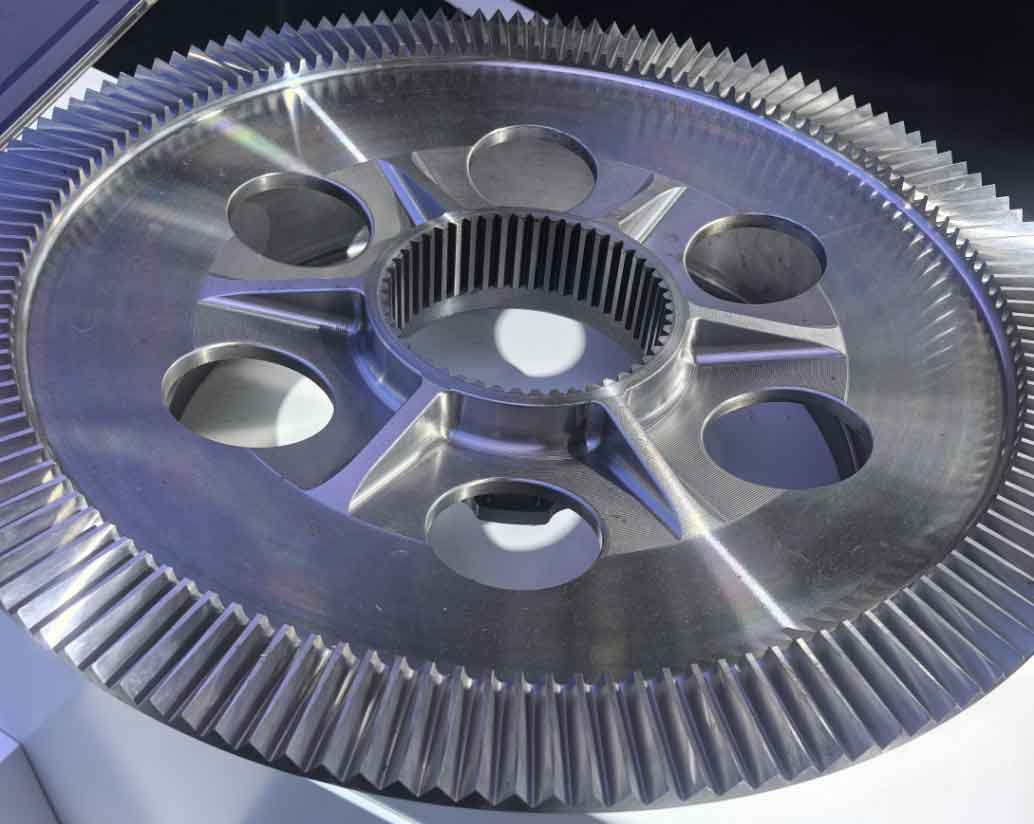
1. Gear Failure Mechanisms
Understanding failure modes is fundamental to developing countermeasures in modern gear technology:
| Failure Mode | Mechanism | Critical Parameters |
|---|---|---|
| Tooth Fracture | Fatigue crack propagation from stress concentration at tooth root |
$$ \sigma_b = \frac{K \cdot F_t}{b \cdot m \cdot Y} $$ where $\sigma_b$ = bending stress, $K$ = load factor, $F_t$ = tangential force, $b$ = face width, $m$ = module, $Y$ = form factor |
| Pitting | Subsurface crack formation due to Hertzian contact stress |
$$ \sigma_H = Z_E \sqrt{\frac{F_t}{b \cdot d_1} \cdot \frac{u \pm 1}{u} $$ where $\sigma_H$ = contact stress, $Z_E$ = elasticity factor, $d_1$ = pinion diameter, $u$ = gear ratio |
| Scuffing | Localized welding from lubricant film rupture | Flash temperature $T_f = \frac{\mu \cdot v_g \cdot \sqrt{p_{max}}}{\sqrt{b_1 \cdot v_1 + b_2 \cdot v_2}}$ |
2. Installation and Maintenance Protocols
Precision installation extends service life through improved load distribution:
- Alignment Procedures: Laser alignment to achieve angular misalignment < 0.05° and parallel offset < 0.02 mm/m
- Lubrication Management:
- Optical emission spectroscopy for oil condition monitoring
- Minimum film thickness calculation: $$ h_{min} = 2.65 \frac{R^{0.43} (\eta_0 v)^{0.7}}{E’^{0.03} w^{0.13}} $$
where $\eta_0$ = dynamic viscosity, $v$ = rolling speed, $E’$ = equivalent modulus, $w$ = load per unit width
3. Surface Enhancement Techniques
Advanced gear technology employs multiple surface engineering approaches:
| Treatment | Process Parameters | Hardness Improvement | Residual Stress (MPa) |
|---|---|---|---|
| Carburizing | 925°C, 4-8 hours, 0.8-1.2% surface carbon | 58-63 HRC | -300 to -500 |
| Nitriding | 500°C, 20-80 hours, 0.3-0.6mm case depth | 65-72 HRC | -600 to -1000 |
| WPC Shot Peening | 0.3-0.6mm shot, 200-300 m/s velocity | +15-25% core hardness | -800 to -1200 |
4. Material and Design Optimization
Modern gear technology leverages computational methods for design enhancement:
- Material Selection Matrix:
Application Material Heat Treatment Surface Hardness (HRC) Core Hardness (HRC) High-Speed 16MnCr5 Case Carburizing 60-62 35-40 Heavy-Duty 42CrMo4 Nitriding 65-70 28-32 - Microgeometry Optimization:
- Profile modifications: $$ \delta_{mod} = k_1 \cdot F_t^{0.8} + k_2 \cdot v^{0.5} $$
- Lead crowning: $$ C_\beta = \frac{F_\beta \cdot L^3}{48 \cdot E \cdot I} $$
5. Precision Manufacturing Controls
Advanced gear technology requires micron-level process discipline:
- Blank Tolerance Standards:
- Bore diameter tolerance: IT5-IT6
- Runout: < 0.015 mm per 100 mm diameter
- Face parallelism: < 0.01 mm/100 mm
- Tooling Management:
- Coated carbide tools with $Al_2O_3/TiCN$ multilayer coatings
- Tool wear monitoring through power consumption analysis
- Process Capability: Gear grinding achieving DIN class 5-6 with surface roughness $R_a = 0.4-0.8 \mu m$
6. Integrated Life Extension Strategy
A comprehensive approach combines multiple gear technology solutions:
$$ L_{extended} = K_m \cdot K_s \cdot K_l \cdot L_{basic} $$
Where $L_{basic}$ = calculated basic rating life, $K_m$ = material factor (1.2-1.8), $K_s$ = surface treatment factor (1.3-2.0), $K_l$ = lubrication factor (1.1-1.5). Implementation of these synergistic measures yields typical service life improvements:
| Improvement Measure | Life Extension Factor | Failure Rate Reduction |
|---|---|---|
| Precision Grinding | 1.8-2.5× | 45-60% |
| Residual Stress Optimization | 2.0-3.0× | 50-67% |
| Microgeometry Correction | 1.5-2.2× | 33-55% |
| Integrated Approach | 4.0-7.5× | 75-87% |
The continuous advancement in gear technology enables significant extension of reducer service life through synergistic application of surface engineering, precision manufacturing, and computational design optimization. Implementation of these measures contributes substantially to sustainable industrial practices by reducing maintenance frequency and resource consumption.