
In this paper, we investigate the mechanical behavior of a novel 35-type pumping unit designed for deep well extraction, focusing on its rack and pinion gear transmission system. The rack and pinion mechanism is central to converting rotational motion into linear reciprocating movement, which is critical for efficient oil extraction. Deep well operations often face challenges such as high energy consumption and short operational cycles with electric submersible pumps. By analyzing the rack and pinion gear system, we aim to enhance the reliability and performance of this pumping unit. We begin by establishing a theoretical model for the reversing process of the rack and pinion transmission, derive force variation laws, and perform dynamic simulations using Adams software to study the system’s behavior under various conditions. The results provide insights into force distributions, dynamic characteristics, and optimal counterweight settings, which are essential for improving the rack and pinion gear design and overall system durability.
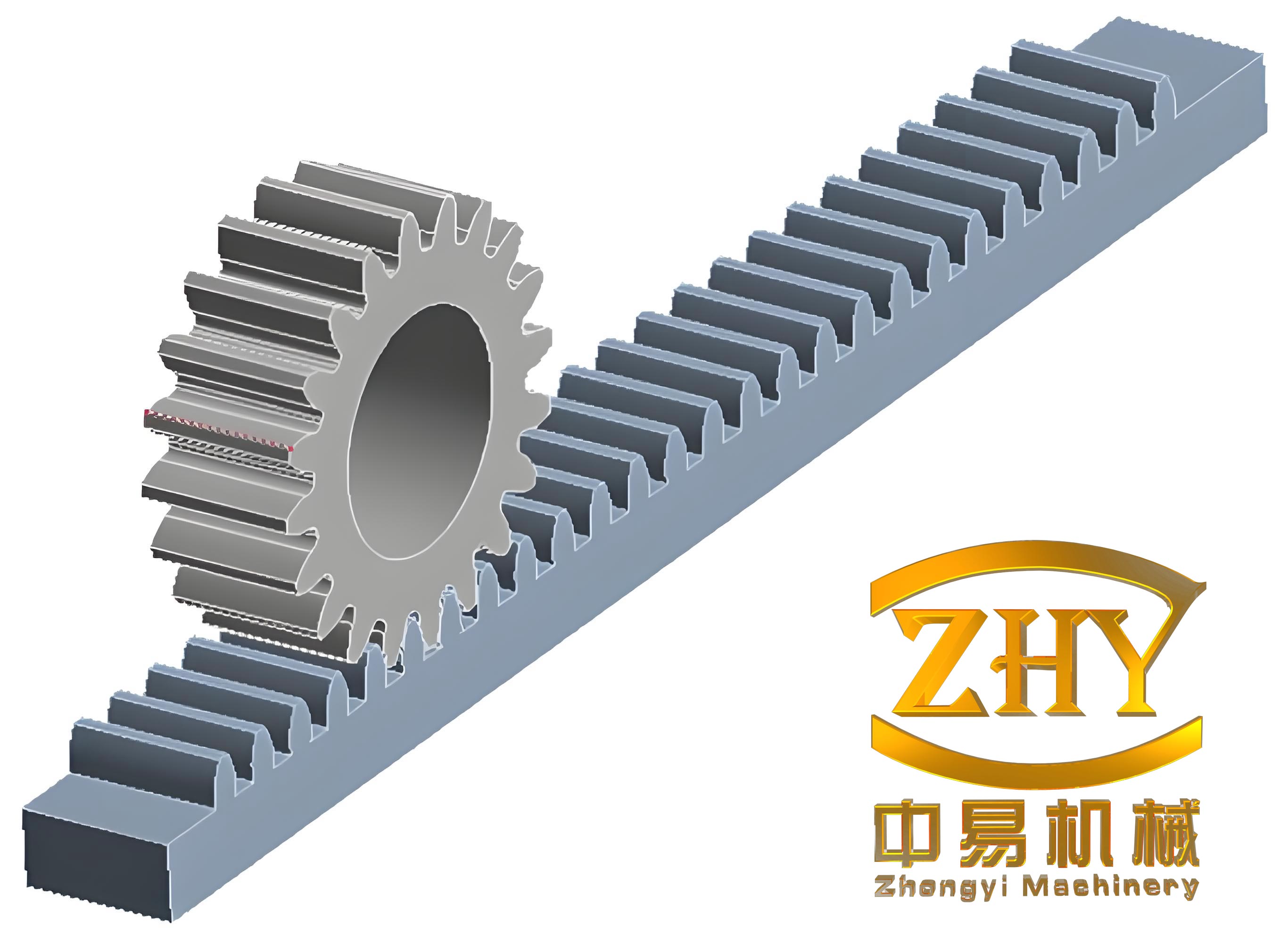
The pumping unit employs a rack and pinion gear system as its primary transmission mechanism, consisting of a long环形齿条 (rack) and a pinion gear. This rack and pinion arrangement allows for smooth conversion of motor rotation into linear motion, enabling long strokes and low冲次 operations. The rack is designed as a环形 structure with straight and curved segments, interacting with the pinion gear to facilitate reciprocating movement. Other components include roller assemblies that constrain the rack’s motion along an H-shaped轨道, ensuring stability during operation. The rack and pinion gear system is subjected to significant loads during deep well extraction, making it crucial to understand its mechanical response. In the following sections, we delve into the theoretical analysis and simulation of this rack and pinion transmission to identify key factors affecting its performance.
To analyze the reversing process of the rack and pinion gear transmission, we develop a mechanical model that accounts for the interaction between the pinion gear and the rack. The reversing process occurs when the rack changes direction from upward to downward motion or vice versa. During this phase, the rack and pinion experience varying forces due to changes in velocity and acceleration. We consider a planar coordinate system with the origin at the pivot point of the swing arm. Let θ be the angle between the swing arm centerline and the y-axis, ω be the angular velocity of the pinion gear, and φ be the rotation angle of the pinion (ranging from 0 to π/2 for the upward-to-downward reversal). The relationship between θ and φ is given by:
$$ \sin \theta = -\frac{R \cos \phi}{l} $$
and
$$ \cos \theta = \frac{\sqrt{l^2 – (R \cos \phi)^2}}{l} $$
where R is the center distance between the pinion gear and the semi-circular rack segment (R = R1 + R2, with R1 as the pinion pitch radius and R2 as the rack segment radius), and l is the length of the swing arm. The y-direction displacement s of the rack is expressed as s = l cos θ – R sin φ. Substituting the expressions for cos θ and sin φ, we obtain:
$$ s = \sqrt{l^2 – [R \cos(\omega t)]^2} – R \sin(\omega t) $$
Differentiating this with respect to time gives the y-direction velocity v of the rack:
$$ v = \frac{R^2 \omega \cos \phi \sin \phi}{\sqrt{l^2 – R^2 \cos^2 \phi}} – R \omega \cos \phi $$
The power input from the motor is transmitted through the rack and pinion gear system, and neglecting losses, the output power P driving the rack is P = F v, where F is the working load (difference between suspension point load and counterweight). The tangential force Fe at the pinion-rack interface is derived from P and the circumferential velocity vc = ω R1 of the pinion:
$$ F_e = \frac{P}{v_c} = \frac{F v}{\omega R_1} $$
Substituting v from the previous equation, we get:
$$ F_e = \frac{F R^2 \cos \phi \sin \phi}{R_1 \sqrt{l^2 – R^2 \cos^2 \phi}} – \frac{F R \cos \phi}{R_1} $$
The normal force Fc between the rack and pinion gear, considering a pressure angle α of 20°, is:
$$ F_c = \frac{F_e}{\cos \alpha} = \frac{F R^2 \cos \phi \sin \phi}{R_1 \sqrt{l^2 – R^2 \cos^2 \phi} \cos \alpha} – \frac{F R \cos \phi}{R_1 \cos \alpha} $$
This force Fc acts at an angle β = φ – α to the y-axis, so its components in the x and y directions are:
$$ F_{cx} = F_c \sin(\phi – \alpha) = \left( \frac{F R^2 \cos \phi \sin \phi}{R_1 \sqrt{l^2 – R^2 \cos^2 \phi} \cos \alpha} – \frac{F R \cos \phi}{R_1 \cos \alpha} \right) \sin(\phi – \alpha) $$
and
$$ F_{cy} = F_c \cos(\phi – \alpha) = \left( \frac{F R^2 \cos \phi \sin \phi}{R_1 \sqrt{l^2 – R^2 \cos^2 \phi} \cos \alpha} – \frac{F R \cos \phi}{R_1 \cos \alpha} \right) \cos(\phi – \alpha) $$
For the downward-to-upward reversal, similar equations apply by replacing F with -F and adjusting the φ range to π/2 ≤ φ ≤ π. The force variations during reversal show that the rack and pinion gear system experiences significant changes in direction and magnitude, with peak forces occurring at specific angles. For instance, when φ = π/9, Fcx is zero, and when φ = 11π/18, Fcy is zero. At φ = π/2, the velocity is zero, resulting in zero force. Using typical design parameters (e.g., R = 0.5 m, R1 = 0.1 m, l = 2 m, F = 100 kN), the maximum forces are approximately 92 kN in the x-direction and 138 kN in the y-direction. This analysis highlights the dynamic nature of the rack and pinion gear transmission during reversal and underscores the importance of optimizing geometric parameters to minimize stress concentrations.
To further investigate the rack and pinion gear system, we conduct dynamic simulations using Adams software. The model includes the rack, pinion gear, rollers, and other components, with contacts defined between the rack and pinion, rollers and轨道s. The simulation parameters are set for a冲次 of 1.5 cycles per minute, corresponding to a pinion angular velocity of 127°/s, and a total simulation time of 100 s (2.5 cycles). The suspension point load is modeled as a time-varying function based on a theoretical indicator diagram for a 3000 m well depth, accounting for static and dynamic loads. The counterweight is adjusted through pneumatic balance settings. The dynamic responses of the rack and rollers are analyzed to understand the rack and pinion gear behavior under operational conditions.
The force on the rack in the x and y directions varies significantly during different phases of operation. For example, during the upward stroke匀速段, the rack experiences positive x-direction forces averaging around 35 kN and negative y-direction forces around -100 kN. In contrast, during the downward stroke匀速段, the x-direction forces are negative at approximately -30 kN, and the y-direction forces are positive at 90 kN. The reversal phases show rapid force fluctuations due to acceleration changes and load variations. The maximum forces during reversal are about 53 kN in the x-direction and 115 kN in the y-direction, which are lower than theoretical values due to the elastic effects of the rod string considered in the simulation. This demonstrates the complex interplay between inertial loads and the rack and pinion gear dynamics, emphasizing the need for robust design to handle these variations.
The rollers, which constrain the rack’s motion, also exhibit dynamic behavior. Large rollers provide z-direction constraints, and their forces vary with the stroke phase. For instance, large roller 1 has z-direction forces of around -18 kN during the upward stroke and 5 kN during the downward stroke. The forces on同组,同侧, and对角 rollers differ in direction and magnitude due to the rack’s tendency to rotate around its x, y, and z axes under the influence of suspension loads, counterweights, and rack and pinion forces. The following table summarizes the z-direction forces for large rollers during different strokes:
| Roller Group | Upward Stroke Force (kN) | Downward Stroke Force (kN) | Force Direction Relationship |
|---|---|---|---|
| 同组 Rollers | -18 to -20 | 5 to 7 | Same direction in upward stroke, opposite in downward |
| 同侧 Rollers | -15 to -18 | 3 to 5 | Opposite direction in upward stroke, same in downward |
| 对角 Rollers | -17 to -19 | 4 to 6 | Always opposite direction |
Small rollers, which provide x-direction constraints, show forces primarily during specific phases. For example, small roller 1 has x-direction forces of about 7.5 kN during the upward stroke and 2 kN during the downward reversal. The forces on other small rollers vary similarly, as shown in the table below:
| Small Roller Type | Force Magnitude (kN) | Primary Phase | Direction |
|---|---|---|---|
| 同组 Rollers | 7.5 (up), 2 (down) | Upward stroke and downward reversal | Opposite between pairs |
| 同侧 Rollers | 6-8 (up), 1-3 (down) | Half stroke and reversal | Same direction |
| 对角 Rollers | 7-9 (up), 2-4 (down) | Reversal and separate strokes | Opposite direction |
These variations are attributed to the moments generated by the rack and pinion forces and load asymmetries, causing the rack to rotate around its axes. The rack and pinion gear interaction plays a key role in these dynamics, as the changing啮合 position alters the force distribution on the rollers. This analysis underscores the importance of considering the entire system in the design of rack and pinion transmissions for pumping units.
The pneumatic counterweight significantly affects the rack and pinion gear system’s dynamics. By varying the counterweight from 5 t to 9 t, we observe changes in the y-direction forces on the rack during upward and downward strokes. The goal is to minimize the difference in force magnitudes between strokes for smoother operation. The table below summarizes the average y-direction forces for different counterweights:
| Counterweight (t) | Upward Stroke Force (kN) | Downward Stroke Force (kN) | Absolute Difference (kN) |
|---|---|---|---|
| 5 | -118.2 | 69.8 | 48.4 |
| 6 | -109.8 | 80.7 | 29.1 |
| 7 | -99.8 | 91.2 | 8.6 |
| 8 | -88.9 | 104.1 | 15.2 |
| 9 | -80.2 | 115.5 | 35.3 |
At a counterweight of 7 t, the force difference is minimized to 8.6 kN, indicating optimal balance for the rack and pinion gear system. This reduces motor power fluctuations and enhances system reliability. The rack and pinion forces are directly influenced by the counterweight, as it affects the net load on the rack during strokes. Thus, proper counterweight selection is crucial for efficient rack and pinion operation in deep well pumping units.
In conclusion, our analysis of the rack and pinion gear transmission in the 35-type pumping unit reveals critical insights into its mechanical behavior. The theoretical model for the reversing process shows that rack and pinion forces depend on geometric parameters like center distance and pinion radius, with peak forces reaching up to 138 kN. Dynamic simulations demonstrate that the rack and pinion system experiences varying forces during different stroke phases, with the rack undergoing rotations around its axes due to load asymmetries. The rollers exhibit complex force patterns that depend on their grouping and position. Optimal pneumatic counterweight of 7 t minimizes force differences between strokes, promoting stable rack and pinion operation. These findings provide a foundation for improving the rack and pinion gear design, enhancing the pumping unit’s durability and efficiency in deep well applications. Future work could explore material optimizations and real-time control strategies for the rack and pinion mechanism to further reduce dynamic impacts.