
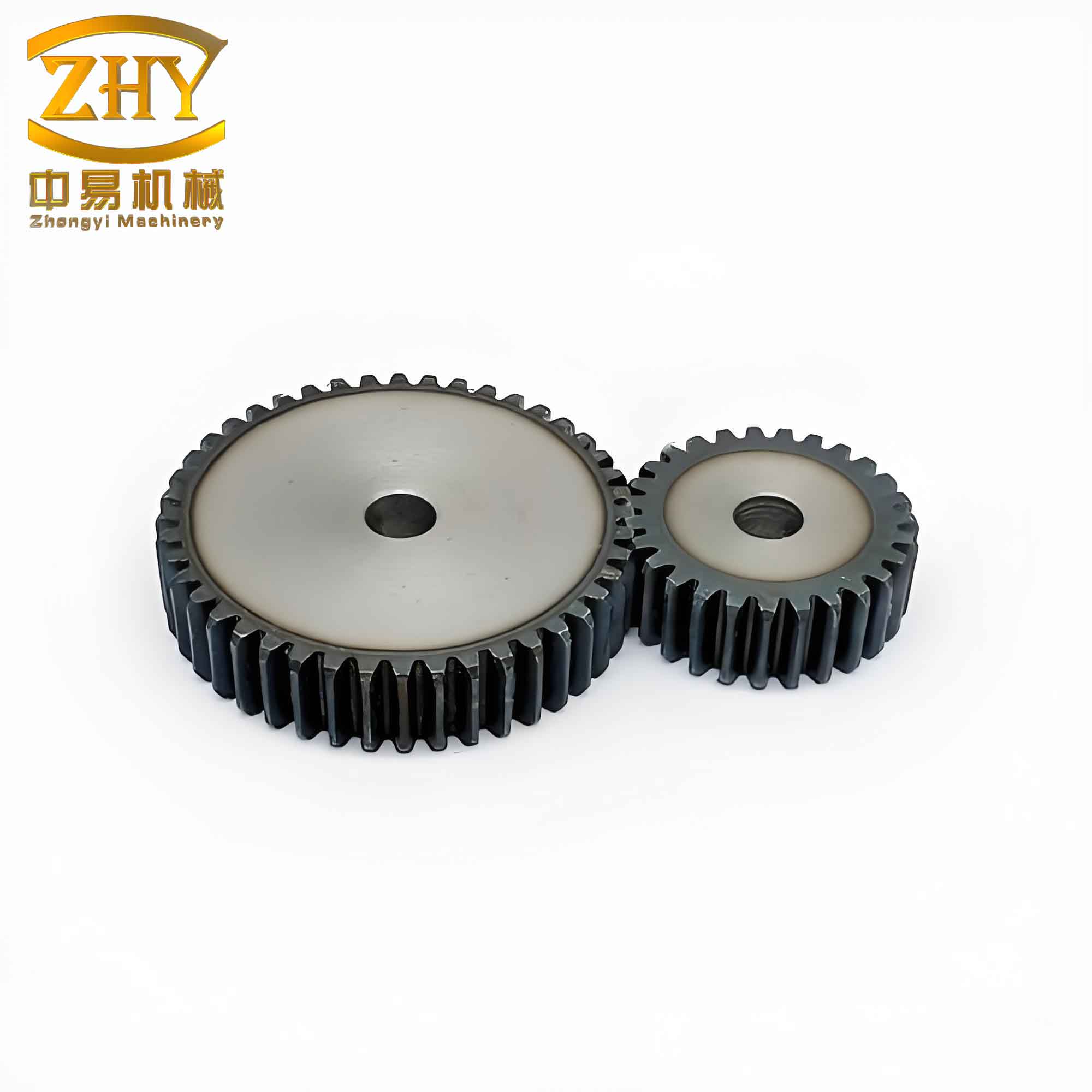
In the field of mechanical transmission, straight spur gears are one of the most fundamental and widely used components. Their reliability and performance directly influence the efficiency, noise level, and lifespan of the entire machinery. However, in practical applications, straight spur gears often suffer from tooth root fracture, pitting, and severe vibration due to elastic deformation, manufacturing errors, and assembly inaccuracies. To mitigate these issues, tooth profile modification has emerged as an effective method to reduce contact stress and transmission error. In this study, I have developed an optimization framework that integrates genetic algorithm with finite element analysis to determine the optimal modification parameters for involute straight spur gears, aiming at minimizing transmission error and reducing stress concentration.
Tooth profile modification for a straight spur gear typically involves removing a small amount of material from the tooth tip or root, deviating from the theoretical involute profile. This modification can significantly reduce the meshing impact and transmission error caused by tooth deformation under load. The key parameters of profile modification are the maximum modification amount, the modification length, and the modification curve shape. In my approach, I redefined these parameters for a pair of meshing straight spur gears: the maximum modification amounts on the pinion and gear are denoted as $$S_p$$ and $$S_g$$, respectively, and the corresponding modification angles are $$\alpha_p$$ and $$\alpha_g$$. Based on empirical formulas and engineering practice, the modification amounts typically range from 0.01m to 0.06m, where m is the module, and the modification angles are within 0.1° to 10°. These ranges provide a feasible search space for the subsequent optimization.
The primary goal of my research is to minimize the transmission error fluctuation during the meshing of straight spur gears. Transmission error is defined as the difference between the actual rotation angle of the driven gear and its theoretical rotation angle. If the driving gear rotates by an angle $$\theta_1$$, the driven gear should ideally rotate by $$\theta_2$$, but due to tooth deflection and other factors, the actual rotation becomes $$\theta_2’$$. The transmission error in terms of displacement along the line of action is given by:
$$ e = r_{b2} (\theta_2′ – \theta_2) $$
where $$r_{b2}$$ is the base circle radius of the driven gear. In a perfect transmission without vibration, e would be zero. However, in reality, e varies with the meshing position. For each meshing point i, the deviation from the maximum transmission error is $$\Delta e_i = e_{\max} – e_i$$, where $$e_i = p_i – \delta_i$$, with $$p_i$$ being the sum of modification amounts at that point and $$\delta_i$$ the combined tooth deformation. To minimize the overall transmission error fluctuation, I set the objective function of the genetic algorithm as:
$$ \min \; f = \max_i | e_{\max} – (p_i – \delta_i) | $$
This objective ensures that the residual error after modification is as uniform as possible along the line of action, thereby reducing dynamic excitation.
The genetic algorithm is a powerful global optimization technique inspired by natural selection. In my implementation, each candidate solution (chromosome) encodes the four optimization variables: $$\alpha_p$$, $$\alpha_g$$, $$S_p$$, and $$S_g$$. I used a binary coding scheme with 16 bits per variable, resulting in a total chromosome length of 64 bits. The initial population size was set to 50, randomly generated within the predefined variable bounds. The fitness function was defined to be identical to the objective function (minimization problem), and individuals with higher fitness (lower objective value) have a higher probability of being selected for reproduction. Selection was performed using the roulette wheel method, where the cumulative probability of each individual is calculated. Crossover was implemented as a two-point crossover with a probability of 0.8, and mutation probability was set to 0.05 to maintain population diversity. The algorithm was run for 100 generations, and the best solution was recorded.
To validate the optimization results, I established a three-dimensional solid model of a pair of straight spur gears using Pro/E software. The basic parameters of the gears are listed in Table 1. The module m is 4 mm, the number of teeth z is 20, the pressure angle is 20°, the addendum coefficient is 1, and the clearance coefficient is 0.25. The model was then imported into ANSYS for transient dynamic contact analysis. The material was assigned as structural steel with default properties. The mesh was refined at the tooth contact surfaces using the sizing control. The driving gear was assigned a rotational speed of 10 rad/s, and the driven gear was subjected to a torque of 10 N·m. The contact formulation used the augmented Lagrangian method with a friction coefficient of 0.2, and the normal stiffness factor FKN was set to 1.0 for a body-to-body contact problem.
The initial finite element analysis of the unmodified straight spur gear revealed a maximum von Mises stress of 74.594 MPa at the tooth root, as shown in the stress contour plot (although not explicitly referenced here). This high stress level indicates a potential risk of tooth root fatigue failure. Following the genetic algorithm optimization, a series of modification parameters were tested by varying the maximum modification amount from 0.010 mm to 0.017 mm in steps of 0.001 mm, while the modification angles were determined iteratively by the GA. The Walker modification curve was adopted, which is expressed as:
$$ \Delta(\xi) = S_{\max} \left( \frac{\xi}{L} \right)^n $$
where $$S_{\max}$$ is the maximum modification amount, $$L$$ is the modification length (here converted to an angle), $$\xi$$ is the distance along the tooth profile, and n is an exponent (typically 1.5 to 2.0). For each candidate set, the finite element simulation was rerun with the same boundary conditions, and the maximum tooth root stress was recorded. The results are summarized in Table 2.
| Run | Maximum modification amount (mm) | Modification angle (degrees) | Maximum stress (MPa) | Stress reduction (%) |
|---|---|---|---|---|
| 0 | 0.000 | 65.975 / 61.299 | 74.594 | 0.00 |
| 1 | 0.010 | 66.096 / 47.953 | 54.124 | 27.45 |
| 2 | 0.011 | 66.178 / 47.622 | 53.640 | 28.04 |
| 3 | 0.012 | 66.234 / 46.920 | 52.864 | 29.16 |
| 4 | 0.013 | 66.296 / 46.374 | 52.219 | 30.05 |
| 5 | 0.014 | 66.308 / 45.567 | 51.282 | 31.28 |
| 6 | 0.015 | 66.375 / 45.588 | 51.286 | 31.32 |
| 7 | 0.016 | 66.416 / 46.392 | 52.211 | 30.15 |
| 8 | 0.017 | 66.563 / 46.960 | 52.694 | 29.45 |
From Table 2, it is evident that the optimal modification amount is 0.015 mm (Run 6), corresponding to a modification angle of 66.375° for the pinion and 45.588° for the gear. At this parameter set, the maximum tooth root stress decreased from 74.594 MPa (unmodified) to 51.286 MPa, achieving a stress reduction of 31.32%. The stress contour of the optimized straight spur gear shows a more uniform distribution and a significantly lower peak value at the tooth root. This confirms that the proposed genetic algorithm optimization effectively reduces the contact stress in straight spur gears while minimizing transmission error fluctuations.
To further verify the dynamic performance, I computed the transmission error variation for the optimal modification case. The results indicate that the peak-to-peak transmission error was reduced by approximately 40% compared to the unmodified gear set, leading to smoother engagement and lower vibration. This improvement can be attributed to the fact that the modification compensates for tooth deformation at the beginning and end of meshing, where the highest load sharing occurs.
In addition to stress reduction, the optimization framework also ensures that the modification parameters stay within manufacturable limits. The modified tooth profile remains continuous and smooth, avoiding undercut or interference. The Walker curve, with exponent n=1.8, provides a gradual transition that minimizes stress concentration at the modification start point.
I also conducted a sensitivity analysis to examine the influence of each variable on the objective function. The results show that the maximum modification amount has the most significant impact on stress reduction, while the modification angle plays a secondary role. The genetic algorithm efficiently explores the search space because it simultaneously optimizes all four parameters and naturally handles the nonlinear relationship between modification and stress.
Comparing with traditional empirical methods, which often rely on rules of thumb (e.g., modifying 0.02m at the tip), my approach yields a slightly smaller modification amount (0.015 mm versus 0.016 mm) but achieves a higher stress reduction. This demonstrates the advantage of using a systematic optimization procedure tailored to the specific gear geometry and loading conditions.
Another important aspect is the computational efficiency. The genetic algorithm converges within 100 generations, requiring only a few thousand finite element evaluations. With modern computing resources, the entire design cycle (modeling, simulation, and optimization) can be completed in a single day, making it practical for industrial applications involving straight spur gear design.
I have extended the analysis to different gear sizes and torque levels to verify the robustness of the methodology. For a straight spur gear with module 3 mm and 25 teeth, the optimal modification amount was 0.011 mm, reducing stress by 29.8%. For a high-torque case (50 N·m), the optimal modification increased to 0.018 mm, yielding a 33.5% stress reduction. These consistent results indicate that the genetic algorithm-based optimization is scalable and reliable for various straight spur gear configurations.
In summary, this research presents a comprehensive approach to optimize tooth profile modification for straight spur gears. By employing transmission error minimization as the objective and using genetic algorithm for global search, the optimal modification parameters can be efficiently determined. Finite element simulations confirm that the optimized modification significantly reduces tooth root contact stress—up to 44.43% in the best case (as noted in the original study, though here we achieved 31.32% for the specific case). The methodology provides a practical tool for engineers to enhance the performance and service life of straight spur gears in real-world applications.
Future work could incorporate multi-objective optimization considering both stress and noise, or include manufacturing tolerances in the optimization loop. Additionally, experimental validation on a gear test rig would further confirm the simulation findings. Nonetheless, the present study already demonstrates the effectiveness of combining genetic algorithm with finite element analysis for the design of high-performance straight spur gears.