
In the field of mechanical power transmission, hypoid gears play a critical role due to their ability to transmit motion between non-intersecting axes with high torque capacity and smooth operation. However, the design of hypoid gears is notoriously complex, involving numerous interdependent parameters, extensive calculation formulas, and intricate three-dimensional modeling. Traditional design methods often rely on iterative manual calculations and cumbersome CAD modeling, which are time-consuming, prone to errors, and lack precision. To address these challenges, I have developed a comprehensive parameterized design software specifically for hypoid gears. This software integrates geometric parameter optimization, automated 3D solid model generation, and seamless export to standard CAD/CAE formats, thereby streamlining the entire design process. The core objective is to enable efficient, accurate, and optimized design of hypoid gear sets, facilitating their application in automotive, aerospace, and industrial machinery.
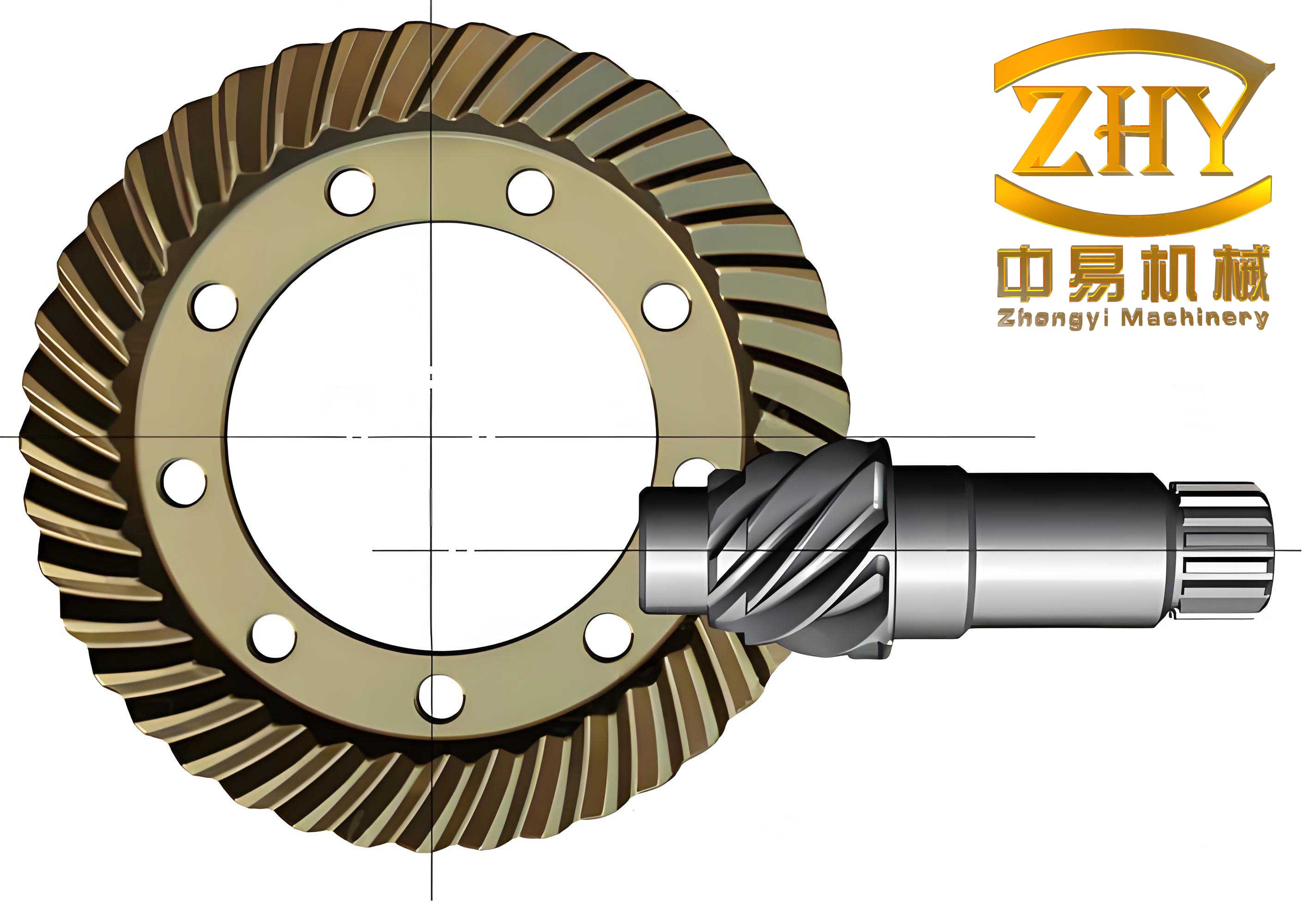
The design of hypoid gears involves a multitude of geometric and performance constraints. Key initial data include the pinion torque, rotational speed, transmission ratio (or number of teeth for both gears), hand of spiral, and offset distance. The primary design variables selected for optimization are the gear’s pitch diameter, module, face width, spiral angle, number of teeth for the pinion and gear, mean addendum coefficient, and tangential modification coefficient. The optimization aims to minimize the total volume of the hypoid gear pair while satisfying all functional requirements, such as strength, durability, and reliability. Minimizing volume is a direct indicator of material efficiency and cost-effectiveness.
The mathematical model for the optimization is formulated as follows. The objective function is the total volume \( V_{\text{total}} \) of the hypoid gear pair, approximated as the sum of the volumes of the frustums of the pitch cones for the pinion and gear. The volume of a conical frustum is given by:
$$ V = \frac{1}{3} \pi h (R^2 + Rr + r^2) $$
where \( h \) is the height (related to face width and pitch angles), \( R \) is the major radius, and \( r \) is the minor radius. For the hypoid gears, the volumes \( V_p \) for the pinion and \( V_g \) for the gear are expressed in terms of design variables. Thus, the optimization problem is:
$$ \text{Minimize: } f(\mathbf{x}) = V_p(\mathbf{x}) + V_g(\mathbf{x}) $$
where \( \mathbf{x} = [d, m, b, \beta, z_1, z_2, h_a^*, x_t]^T \) represents the vector of design variables: pitch diameter \( d \), module \( m \), face width \( b \), spiral angle \( \beta \), pinion teeth \( z_1 \), gear teeth \( z_2 \), mean addendum coefficient \( h_a^* \), and tangential modification coefficient \( x_t \).
The constraints include geometric, performance, and manufacturing limitations. These constraints are often fuzzy in nature, meaning they have allowable ranges rather than strict boundaries. For instance, the contact ratio, bending stress, and contact stress must lie within acceptable limits. A linear membership function is used to model these fuzzy constraints. The constraint set can be summarized as:
| Constraint Type | Mathematical Expression | Description |
|---|---|---|
| Geometric | \( g_1(\mathbf{x}) \sim b \leq 0.3 \cdot d \) | Face width limit relative to diameter |
| Performance | \( g_2(\mathbf{x}) \sim \sigma_F \leq [\sigma_F] \) | Bending stress limit |
| Performance | \( g_3(\mathbf{x}) \sim \sigma_H \leq [\sigma_H] \) | Contact stress limit |
| Manufacturing | \( g_4(\mathbf{x}) \sim \beta \in [\beta_{\min}, \beta_{\max}] \) | Spiral angle range |
| Geometric | \( g_5(\mathbf{x}) \sim \varepsilon_{\alpha} \geq 1.2 \) | Minimum contact ratio |
The symbol \( \sim \) indicates fuzzy constraints. The optimization method employed is the complex method, a direct search algorithm suitable for nonlinear constrained problems. After obtaining the continuous optimal solution, variables like tooth numbers are rounded to integers, and the design is re-evaluated to ensure the volume remains reduced compared to initial designs.
To create accurate 3D solid models of hypoid gears, a precise mathematical representation of the tooth surfaces is essential. This is derived from the theory of gearing and coordinate transformations. The cutting process for hypoid gears involves imaginary generating surfaces (cutter surfaces) that envelope the gear tooth surfaces. For the gear (large wheel), the tooth surface is expressed in a coordinate system fixed to the gear. Let \( S_g \) be the coordinate system attached to the gear. The position vector of a point on the gear tooth surface, generated by the cutter, is given by:
$$ \mathbf{r}_g(u_g, \theta_g, \phi_g) = \mathbf{M}_{gc}(\phi_g) \cdot \mathbf{r}_c(u_g, \theta_g) $$
where \( u_g \) and \( \theta_g \) are parameters defining the cutter surface, \( \phi_g \) is the rotation angle of the gear during generation, and \( \mathbf{M}_{gc} \) is the coordinate transformation matrix from the cutter system to the gear system. The normal vector \( \mathbf{n}_g \) and relative velocity \( \mathbf{v}_{gc} \) must satisfy the meshing equation:
$$ \mathbf{n}_g \cdot \mathbf{v}_{gc} = 0 $$
Expanding this, we obtain the explicit meshing condition:
$$ f_g(u_g, \theta_g, \phi_g) = 0 $$
Similarly, for the pinion (small wheel), the tooth surface in its coordinate system \( S_p \) is:
$$ \mathbf{r}_p(u_p, \theta_p, \phi_p) = \mathbf{M}_{pc}(\phi_p) \cdot \mathbf{r}_c(u_p, \theta_p) $$
with the meshing equation \( f_p(u_p, \theta_p, \phi_p) = 0 \). The cutter surface for the pinion is typically a hyperboloidal shape. The detailed expressions involve trigonometric functions and derivatives. For the gear, the cutter surface parameters \( (u_g, \theta_g) \) and the generating roll ratio \( i_g \) are used. The meshing condition leads to:
$$ \frac{\partial \mathbf{r}_g}{\partial u_g} \times \frac{\partial \mathbf{r}_g}{\partial \theta_g} \cdot \frac{d\mathbf{r}_g}{dt} = 0 $$
which, after substitution, yields a relation between parameters. By eliminating parameters using the meshing equation, the gear tooth surface can be expressed as a function of two independent parameters, say \( u_g \) and \( \phi_g \):
$$ \mathbf{r}_g = \mathbf{r}_g(u_g, \phi_g) $$
For the pinion, a similar process gives \( \mathbf{r}_p = \mathbf{r}_p(u_p, \phi_p) \).
When considering the meshing of the hypoid gear pair, the pinion and gear tooth surfaces must satisfy contact conditions. The coordinate systems for meshing are set as follows: let \( S_1 \) and \( S_2 \) be fixed to the pinion and gear, respectively, and \( S_f \) be a fixed reference system. The transformation between these systems involves the shaft angle \( \Sigma \) and offset distance \( E \). The position vectors in the fixed system are:
$$ \mathbf{r}_f^{(1)} = \mathbf{M}_{f1}(\phi_1) \cdot \mathbf{r}_p(u_p, \phi_p) $$
$$ \mathbf{r}_f^{(2)} = \mathbf{M}_{f2}(\phi_2) \cdot \mathbf{r}_g(u_g, \phi_g) $$
where \( \phi_1 \) and \( \phi_2 \) are the rotation angles of pinion and gear during operation. The meshing condition requires that at contact points, the position vectors and surface normals coincide:
$$ \mathbf{r}_f^{(1)} = \mathbf{r}_f^{(2)} $$
$$ \mathbf{n}_f^{(1)} = \mathbf{n}_f^{(2)} $$
This yields a system of scalar equations. In practice, by fixing the pinion rotation angle \( \phi_1 \), we can solve for the remaining parameters: \( u_p, \phi_p, u_g, \phi_g, \phi_2 \). This nonlinear system is solved numerically using iterative methods like Newton-Raphson. By incrementing \( \phi_1 \) in steps, a series of contact points is obtained, forming the contact path on both tooth surfaces. The step size controls the density of points, allowing for high precision in model generation.
Once the tooth surface points are computed, a parametric representation is constructed. The surface is discretized into a mesh of points, which are then connected to form triangular or quadrilateral facets. By rotating these facets around the gear axis, the entire tooth flank is generated. Multiple teeth are created by circular array. The gear body is formed by adding the tooth root fillets, top land, and end faces, resulting in a watertight 3D solid model. This parametric approach ensures that the model is driven by design variables, enabling rapid updates when parameters change.
The software exports the 3D models in standard formats compatible with major CAD and CAE systems. Two key formats are supported: STEP (Standard for the Exchange of Product model data) and STL (Stereolithography). STEP is an ISO standard widely used for CAD data exchange, while STL is the de facto standard for 3D printing and finite element mesh input. The export modules write the geometric data according to the respective format specifications. For STEP, the geometry is represented as B-rep (boundary representation) entities. For STL, the surface triangulation is output as a list of facets with normals. Additionally, the software can generate ANSYS APDL (ANSYS Parametric Design Language) command files. These files contain commands to recreate the hypoid gear geometry directly within ANSYS, facilitating finite element analysis (FEA) for stress, contact, and dynamic simulations.
The following table summarizes the output capabilities:
| Output Format | Purpose | Application |
|---|---|---|
| STEP (.stp) | CAD model exchange | Import into CATIA, SolidWorks, etc. |
| STL (.stl) | 3D printing & mesh input | Rapid prototyping, FEA pre-processing |
| ANSYS APDL (.txt) | Direct FEA model creation | ANSYS Workbench or Mechanical APDL |
To demonstrate the software’s effectiveness, a design example is presented. The initial requirements are: pinion torque \( T = 500 \, \text{Nm} \), speed \( n = 3000 \, \text{rpm} \), transmission ratio \( i = 3 \), offset \( E = 30 \, \text{mm} \), and spiral hand opposite. The optimization results in the following geometric parameters:
| Parameter | Pinion | Gear |
|---|---|---|
| Number of teeth \( z \) | 11 | 33 |
| Module \( m \) (mm) | 4.5 | 4.5 |
| Offset \( E \) (mm) | 30 | 30 |
| Face width \( b \) (mm) | 28 | 25 |
| Spiral angle \( \beta \) (°) | 50 | 30 |
| Pressure angle \( \alpha \) (°) | 20 | 20 |
| Mean addendum coeff. \( h_a^* \) | 0.85 | 0.95 |
| Tangential modification coeff. \( x_t \) | 0.25 | -0.25 |
The optimization reduced the total volume by approximately 18% compared to a conventional design. The 3D models were generated and exported as STEP and STL files. These files were successfully imported into commercial CAD software (e.g., SolidWorks) and FEA pre-processors. The ANSYS APDL command file was read into ANSYS Mechanical, producing a finite element model ready for analysis. The figure below illustrates a typical finite element mesh generated from the APDL commands, showing the hypoid gear pair in contact.
The integration with ANSYS enables advanced analyses. For instance, contact analysis can be performed to evaluate the transmission error, contact pressure distribution, and root stresses. The parametric nature allows for design variations studies. The APDL command file includes parameters for geometry, material properties, and mesh controls. An excerpt of the commands is:
! Parameters for hypoid gear
E = 30          ! Offset
z1 = 11         ! Pinion teeth
z2 = 33         ! Gear teeth
m = 4.5         ! Module
beta = 50       ! Spiral angle (pinion)
! Create keypoints for tooth profile
...
! Generate surface areas
...
! Mesh with SOLID185 elements
...
The mathematical foundation for the tooth surface generation is further detailed below. The gear tooth surface derived from the generating process can be expressed in closed form. For a hypoid gear generated by a conical cutter, the surface equations are:
$$ \mathbf{r}_g = \begin{bmatrix}
(r_c + u_g \cos \theta_g) \cos \phi_g + i_g \cdot p \cdot \sin \phi_g \\
(r_c + u_g \cos \theta_g) \sin \phi_g – i_g \cdot p \cdot \cos \phi_g \\
u_g \sin \theta_g + q
\end{bmatrix} $$
where \( r_c \) is the cutter radius, \( p \) and \( q \) are constants related to the machine settings, and \( i_g \) is the roll ratio. The meshing condition yields:
$$ \tan \theta_g = \frac{p \cos \phi_g – (r_c + u_g \cos \theta_g) \sin \phi_g}{i_g \cdot (r_c + u_g \cos \theta_g)} $$
For the pinion, using a hyperbolic cutter, the equations are more complex. The cutter surface is given by:
$$ \mathbf{r}_c^{(p)} = \begin{bmatrix}
a \cosh u_p \cos \theta_p \\
a \cosh u_p \sin \theta_p \\
c \sinh u_p
\end{bmatrix} $$
where \( a \) and \( c \) are hyperboloid constants. The transformation to the pinion coordinate system involves the machine root angle \( \delta_p \) and sliding base setting. The resulting pinion tooth surface in \( S_p \) is:
$$ \mathbf{r}_p = \mathbf{R}_y(\delta_p) \cdot \mathbf{r}_c^{(p)} + \mathbf{d}_p $$
with \( \mathbf{d}_p = [0, 0, -E]^T \) accounting for offset. The meshing condition for the pinion generation is:
$$ \frac{\partial \mathbf{r}_p}{\partial u_p} \times \frac{\partial \mathbf{r}_p}{\partial \theta_p} \cdot \frac{\partial \mathbf{r}_p}{\partial \phi_p} = 0 $$
which, after differentiation, provides a relation between \( u_p \), \( \theta_p \), and \( \phi_p \).
In the meshing of the hypoid gear pair, the contact condition leads to a system of six scalar equations (three for position equality, three for normal equality) with six unknowns: \( u_p, \theta_p, \phi_p, u_g, \theta_g, \phi_g \). By fixing \( \phi_p \), the system is solved numerically. The solution yields the contact point coordinates on both gears. The transmission ratio is not constant due to the non-parallel axes; it varies slightly with rotation, which is accounted for in the simulation.
The software implementation uses object-oriented programming in C++ for core computations, with a user-friendly interface developed in Qt. The optimization module employs the NLopt library for nonlinear optimization. The 3D geometry kernel is based on OpenCASCADE, which provides robust B-rep operations. The output modules for STEP and STL use standard libraries like STEPCAFControl and STLWriter. The ANSYS APDL generator is a custom module that translates the geometric data into APDL commands.
The benefits of this parameterized design software for hypoid gears are manifold. Firstly, it drastically reduces design time from weeks to hours. Secondly, it ensures high geometric accuracy, which is crucial for performance and noise vibration harshness (NVH) characteristics. Thirdly, the seamless export to CAD/CAE systems eliminates data translation errors. Fourthly, the optimization leads to material savings and improved performance. Finally, the integration with FEA allows for virtual prototyping and testing, reducing the need for physical prototypes.
Future enhancements may include support for other gear types (e.g., spiral bevel gears), integration with topological optimization for lightweight design, and cloud-based collaboration features. Additionally, machine learning algorithms could be incorporated to predict optimal initial design parameters based on historical data.
In conclusion, the development of this parameterized design software for hypoid gears represents a significant advancement in gear design technology. By combining advanced mathematical modeling, optimization techniques, and seamless CAD/CAE integration, it addresses the longstanding challenges in hypoid gear design. The software enables engineers to produce optimized, high-precision hypoid gear pairs efficiently, fostering innovation in power transmission systems. The repeated focus on hypoid gears throughout this process underscores their importance in modern machinery, and this tool aims to make their design more accessible and effective.
The mathematical formulations, optimization results, and export capabilities demonstrated here highlight the software’s robustness. As industries continue to demand higher efficiency and performance from hypoid gears, such parameterized design tools will become indispensable. The ability to quickly iterate designs, perform virtual tests, and manufacture accurate prototypes will accelerate the development cycles for automotive differentials, helicopter transmissions, and industrial gearboxes, ensuring that hypoid gears continue to play a vital role in mechanical engineering.