
The pursuit of efficient, high-performance, and sustainable manufacturing methodologies is a constant driver in the automotive and heavy machinery sectors. Among critical drivetrain components, hyperboloidal gears stand out due to their exceptional load-bearing capacity, smooth and quiet operation, and the unique ability to transmit motion between non-intersecting, offset axes. This offset characteristic allows for a lower vehicle center of gravity, enhancing stability—a paramount advantage in automotive design. Traditionally, the production of these complex components, particularly the driving pinion, has relied heavily on subtractive machining. This process is inherently wasteful of material, time-consuming, and can interrupt the optimal grain flow within the metal.
Precision forging, or net-shape forming, presents a compelling alternative. By plastically deforming a heated metal blank into a finished or near-finished shape within a closed die, this technology offers significant benefits: drastically improved material utilization, superior mechanical properties due to the formation of continuous, unbroken grain flow lines along the tooth profile, high production rates, and reduced overall cost. While precision forging of simpler gears like spur gears is well-established, the application to complex geometries like hyperboloidal gears, especially the driving pinion with its highly asymmetrical, spatially curved teeth, remains a significant technical challenge. The primary obstacles include ensuring complete die fill without defects, managing the severe non-uniform metal flow, handling high forming loads, and facilitating part ejection.
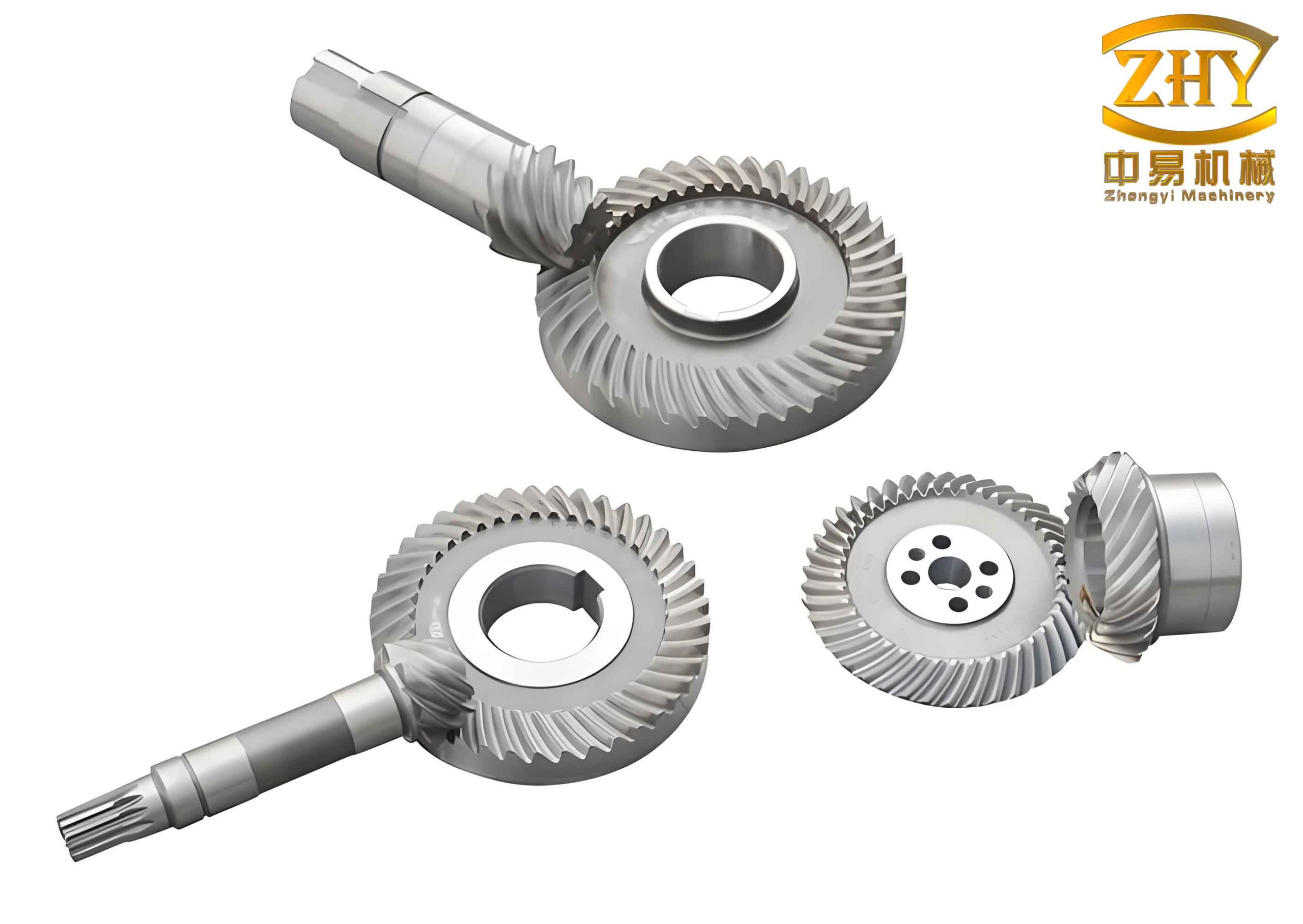
This work focuses on the precision forging process for an automotive differential driving pinion, a classic example of a hyperboloidal gear. We employ a closed-die (occluded) forging approach and utilize advanced 3D finite element method (FEM) simulation to unravel the intricate thermo-mechanical phenomena during forming. The goal is to provide a detailed virtual analysis of metal flow, stress-strain distribution, and load requirements, thereby guiding optimal die design and process parameter selection before committing to expensive physical trials.
1. Process Rationale and Numerical Modeling Framework
1.1 Geometrical Analysis and Preform Design
The successful forging of hyperboloidal gears hinges on intelligent preform design and process sequencing. For this study, the focus is solely on forming the tooth-bearing segment, excluding the shank. The core principle is to compress the metal between the tooth-root cones at both ends, forcing it to flow radially outward into the complex spiral tooth cavities. This path minimizes flow distance and energy consumption. Consequently, the optimal preform must be contained within the volume defined by the root cone and the cylindrical boundaries at the small and large end root circles.
Using commercial CAD software, a 3D model of the target forging was created. Based on the principle of volume constancy in plastic deformation ($V_{preform} = V_{forging}$), the dimensions of a cylindrical preform were calculated. Its end diameters were designed to be slightly smaller than the respective root circle diameters to initiate controlled flow. The basic parameters of the target hyperboloidal gear and the key simulation settings are summarized below.
| Parameter | Value |
|---|---|
| Number of Teeth | 6 |
| Module (mm) | 12.032 |
| Mean Spiral Angle (°) | 45.998 |
| Hand of Spiral | Left |
| Offset (mm) | 44.45 |
| Category | Setting |
|---|---|
| Workpiece Material | 20CrMnTi (Low-Alloy Steel) |
| Die Material | 4Cr5MoSiV1 (AISI H13) |
| Workpiece Temperature | 1100 °C |
| Die Temperature | 350 °C |
| Friction Model | Shear, m=0.3 |
| Punch Speed | 200 mm/s |
| Heat Transfer Coefficient (Workpiece-Die) | 11 N/(s·mm·°C) |
1.2 Finite Element Model Setup
The forging process involves large plastic deformation at elevated temperatures, where thermal effects are coupled with mechanical behavior. Therefore, a coupled thermo-mechanical analysis based on the rigid-viscoplastic finite element formulation is appropriate. The simulation was set up using a commercial FEM package specialized for metal forming. Key assumptions and settings include:
- Material Model: The workpiece (20CrMnTi) was modeled as a plastic, strain-rate and temperature-sensitive body. Its flow stress behavior, determined from isothermal compression tests on a Gleeble thermomechanical simulator, was implemented. The constitutive relationship often follows an Arrhenius-type equation:
$$
\sigma = f(\varepsilon, \dot{\varepsilon}, T)
$$
where $\sigma$ is flow stress, $\varepsilon$ is strain, $\dot{\varepsilon}$ is strain rate, and $T$ is temperature. The dies were defined as rigid bodies, but meshed for heat transfer analysis. - Friction and Heat Transfer: The shear friction model was applied at the tool-workpiece interface: $\tau_f = m k$, where $\tau_f$ is the frictional shear stress, $m$ is the friction factor (0.3), and $k$ is the shear yield strength of the material. Interface heat transfer and convection to the environment were defined with appropriate coefficients.
- Mesh and Boundary Conditions: Both the preform and dies were discretized with approximately 80,000 tetrahedral elements. The punch was assigned a constant velocity downward. The process simulates a closed-die operation where the die cavity is closed before the punch action commences.
2. Numerical Simulation Results and In-Depth Analysis
The FEM simulation provides a complete, time-resolved visualization of the forming process for the hyperboloidal gear. The following sections dissect the critical field variables.
2.1 Evolution of Equivalent (Von-Mises) Stress
The equivalent stress distribution reveals areas of high deformation resistance and potential stress concentration, which are critical for die life prediction. The progression is dynamic and intimately linked to the geometry of hyperboloidal gears.
- Initial Contact (Step ~50): High stress concentrations immediately appear in an annular region near the small-end root circle. This is the first point of contact and constraint, where metal is forced to flow radially into the small-end tooth spaces. Stress decreases radially inwards.
- Small-End Filling (Step ~100): As the small-end teeth begin to fill, the stress at the tooth roots generally exceeds that at the incipient tooth tips due to direct constraint from the die. The region in contact with the bottom die also shows elevated stress.
- Propagation to Large-End (Step ~180): After the small-end is nearly filled, metal flow is redirected towards the large end. This requires circumferential “swirling” of material. Consequently, stress at the small-end tooth tips surpasses that at their roots to drive this flow, while the opposite remains true at the large end. The zone of minimum stress resides at the central core of the billet.
- Final Filling & Corner Radii (Step ~244): In the final stage, as the last corners fill, the stress pattern shifts again. The large-end tooth tips experience peak stress to complete the fill, exceeding the stress at the large-end roots. The maximum equivalent stress of approximately 377 MPa is found in these final-fill corner regions.
This analysis demonstrates a spiraling propagation of the stress concentration zone from the small-end root, to the small-end tip, and finally to the large-end tip, mirroring the inherent spiral geometry of hyperboloidal gears.
2.2 Distribution and Accumulation of Equivalent Plastic Strain
The equivalent strain field indicates the severity and history of deformation. High strain areas correlate with extensive grain flow refinement.
- The strain distribution is highly non-uniform, a direct consequence of the complex fill pattern of hyperboloidal gears.
- Maximum strain ($\epsilon \approx 5.06$) is consistently located at the small-end tooth root fillet area. This region undergoes the most severe and prolonged deformation as it is the primary gateway for metal feeding the entire cavity.
- A strong strain gradient exists from the small end to the large end, with the small end experiencing significantly higher cumulative strain. Furthermore, within any tooth cross-section, strain is highest at the root (intense shear against the die) and decreases towards the tip.
- The central core of the preform exhibits relatively low strain, indicating less refined microstructure in that region compared to the tooth profiles.
2.3 Metal Flow Velocity Fields
The velocity vector fields provide a clear picture of the metal’s flow path, which is crucial for identifying potential defects like folds or laps.
- At the start, material in the central column moves axially downward at high speed. Upon contacting the small-end cavity, the flow diverges radially to fill the small-end teeth.
- Once the small-end is filled, the flow direction transitions into a distinct spiral pattern. Metal from the small-end region flows circumferentially and axially towards the large-end cavity. The velocity vectors clearly show this swirling motion around the gear axis.
- Throughout the process, the flow is orderly without significant backward flow or velocity discontinuities that would indicate folding. This suggests that the chosen preform geometry and closed-die approach are suitable for forging hyperboloidal gears.
2.4 Punch Load-Stroke Analysis
The punch load versus stroke curve, shown conceptually below, is vital for press selection and energy assessment. The curve for forging this hyperboloidal gear can be segmented into three distinct regimes:
- Initial Upsetting (0-10% Stroke): The load increases almost linearly as the cylindrical preform is upset to fill the clearance and make initial contact with the die land. This is a simple compression stage.
- Steady-State Tooth Filling (10-90% Stroke): This is the longest phase, characterized by a steadily rising but relatively smooth load curve. The slope gradually increases as more of the intricate tooth cavity is filled, increasing contact area and frictional resistance. The metal is flowing freely into the evolving space.
- Final Corner Fill and Calibration (90-100% Stroke): In this final short stage, the load increases dramatically. The cavity is essentially full, and further punch displacement compresses the material under near-hydrostatic pressure to force it into the last sharp corners and achieve dimensional accuracy. The load peaks at approximately 1980 kN at the end of the stroke.
The load prediction can be approximated by integrating the stress over the contact area, considering the evolving geometry:
$$
F(t) = \int_{A_c(t)} \sigma(\varepsilon, \dot{\varepsilon}, T) \, dA
$$
where $F(t)$ is the forging load, $A_c(t)$ is the time-varying contact area between the workpiece and the dies.
3. Experimental Validation and Discussion
Guided by the numerical simulation results, a physical forging die set was designed and manufactured. The core element is a split die assembly that allows for the ejection of the forged hyperboloidal gear pinion. The process was conducted on a J53-300 double-disc friction press with a nominal capacity of 3000 kN. A billet of 20CrMnTi was heated to 1100°C and forged in a single blow within the lubricated dies.
The forged component was successfully produced. Visual inspection confirmed that the teeth were fully formed with sharp contours and no visible forging defects such as underfill, folds, or cracks. This physical outcome validated the predictions of the FEM simulation regarding metal flow and fillability. The numerical model accurately captured the sequence of filling from the small end to the large end and the significant forming load required in the final stage.
The successful forging of these hyperboloidal gears demonstrates the feasibility of the closed-die precision forging process for such complex components. The advantages are clear: the forged pinion exhibits continuous grain flow following the tooth profile, which is anticipated to enhance fatigue resistance compared to a machined counterpart. Furthermore, the near-net-shape nature of the process leads to substantial savings in material and a reduction in subsequent machining time, primarily limited to grinding the tooth flanks to achieve final accuracy and heat treatment.
4. Conclusions and Outlook
This integrated study combining 3D finite element simulation and physical experimentation provides comprehensive insights into the precision forging of automotive hyperboloidal gears. The key findings are:
- The closed-die forging process with an appropriately designed cylindrical preform is a viable route for forming the complex, asymmetric teeth of hyperboloidal gears. Metal flow initiates at the small end and propagates in a spiral fashion to fill the large-end cavity.
- Numerical simulation is an indispensable tool for process design. It accurately predicts the dynamic evolution of stress (with a spiraling concentration zone), strain (maximum at small-end roots), and orderly metal flow velocity fields, preventing potential defects.
- The load-stroke characteristic shows three phases: initial upsetting, steady filling, and a final sharp load rise for corner filling. The peak load of ~1980 kN informs press selection.
- Experimental validation on a friction press confirmed the simulation predictions, producing a sound forging with complete die fill.
The research underscores the potential of precision forging as a high-performance, economical manufacturing solution for hyperboloidal gears. Future work will focus on optimizing the preform shape to reduce forming load and improve strain uniformity, analyzing die wear and thermal fatigue based on the simulated stress/temperature fields, and conducting mechanical testing to quantify the performance benefits of the forged grain structure.