
In the realm of power transmission, helical gears are foundational components renowned for their superior performance. Their angled teeth facilitate smoother and quieter operation compared to spur gears, offering higher load capacity and reduced vibration. The widespread application of helical gears across industries such as wind energy, heavy machinery, marine propulsion, and aerospace underscores their critical role. Consequently, the quality and precision of these gears directly dictate the stability, efficiency, and service life of the entire mechanical system. Ensuring the dimensional accuracy and surface integrity of large-diameter helical gears, often exceeding one meter in diameter, presents a significant manufacturing challenge. This article delves into the specialized realm of finishing and corrective machining for large-diameter involute helical gears, drawing from extensive practical experience in precision grinding. The focus will be on form grinding methodologies, process control, and the intricate analysis and mitigation of errors inherent to machining such monumental components.
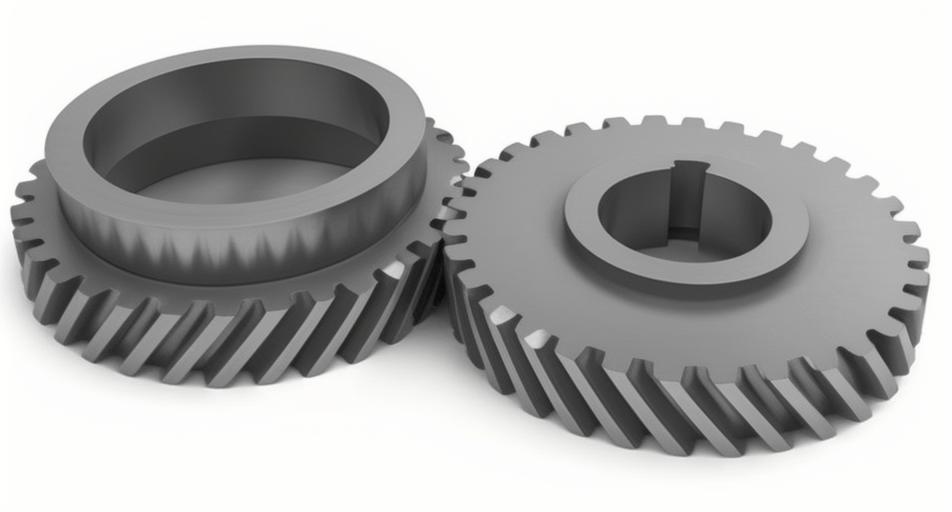
The manufacturing journey of large-diameter helical gears typically begins with rough hobbing or shaping, followed by heat treatment processes like carburizing or induction hardening to achieve the required surface hardness and core toughness. However, heat treatment inevitably induces distortions, making a final high-precision finishing operation indispensable. For large-diameter helical gears, grinding is the definitive process for achieving the stringent accuracy standards mandated for high-performance applications. Among grinding techniques, the form grinding method has proven particularly effective for large-scale helical gears due to its efficiency and ability to maintain a consistent tooth profile. The core principle involves using a grinding wheel whose profile is meticulously dressed to match the exact geometry of the gear tooth space, including the involute profile in the normal section and the required helix angle.
The mathematical foundation of the involute profile is crucial for understanding the grinding process. The coordinates of a point on an involute curve can be expressed as a function of the roll angle or pressure angle. For a base circle of radius \( r_b \), the parametric equations in the transverse plane are:
$$ x = r_b (\cos \theta + \theta \sin \theta) $$
$$ y = r_b (\sin \theta – \theta \cos \theta) $$
Where \( \theta \) is the roll angle (in radians). When dealing with helical gears, this profile exists in the normal plane, which is perpendicular to the tooth’s helix. The relationship between transverse parameters (index *t*) and normal parameters (index *n*) is governed by the helix angle \( \beta \). For instance, the normal module \( m_n \) and transverse module \( m_t \) are related by:
$$ m_t = \frac{m_n}{\cos \beta} $$
Similarly, the normal pressure angle \( \alpha_n \) (typically 20°) and transverse pressure angle \( \alpha_t \) are related by:
$$ \tan \alpha_t = \frac{\tan \alpha_n}{\cos \beta} $$
These formulas are essential for correctly calculating the wheel profile and programming the grinding machine.
Form Grinding Methodology for Large-Diameter Helical Gears
The selection of form grinding for large-diameter helical gears is driven by several compelling advantages. The primary benefit is the high material removal rate achievable due to the full contact area between the contoured grinding wheel and the tooth flank. This reduces overall machining time—a critical factor for large components. Furthermore, the grinding contact line does not coincide with the gear’s theoretical line of action, preserving the integrity of the involute profile essential for smooth meshing. The process involves a CNC-controlled multi-axis machine where the workpiece rotates about its axis while the form wheel executes a complex, synchronized motion to generate the helix.
A critical element of successful form grinding is the grinding wheel itself. For hard materials like case-hardened steel, vitrified-bond cubic boron nitride (CBN) wheels are often the tool of choice due to their exceptional hardness, thermal stability, and wear resistance. However, to maintain the precise form on the wheel against inevitable wear, in-process dressing is mandatory. This is typically accomplished using a rotary diamond or CBN dressing roll. The dressing roll, which carries the inverse of the desired tooth space profile, is traversed across the grinding wheel to regenerate its form. The relationship between the gear parameters and the required dressing roll geometry is complex and requires precise computation.
The grinding process can be conceptualized as a simulated meshing between the grinding wheel and the workpiece gear. In a practical setup, a virtual “generating” motion is often employed. The workpiece rotates, and the wheel, tilted to the helix angle \( \beta \), simultaneously performs a reciprocating stroke along the tooth face width and a synchronized radial in-feed motion. This coordinated movement, controlled by CNC, ensures that each point on the tooth flank is correctly generated. The fundamental kinematic relationship between workpiece rotation \( \phi_w \) and wheel axial stroke \( S_x \) is given by:
$$ S_x = \frac{P_z \cdot \phi_w}{2\pi} $$
Where \( P_z \) is the lead of the helix, calculated as \( P_z = \pi \cdot d \cdot \cot \beta \), and \( d \) is the reference diameter of the gear.
| Method | Principle | Advantages for Large Gears | Limitations |
|---|---|---|---|
| Form Grinding | Wheel profile matches gear tooth space exactly. Material removed by full-form contact. | High removal rate, suitable for batch production, excellent profile consistency. | Complex dressing system required, specialized wheel for each module/pressure angle. |
| Generative Grinding (e.g., continuous generation) | Wheel (shaped like a rack or worm) and workpiece mesh in a simulated rolling motion. | Extremely high accuracy, flexible for different gear specs with same wheel, excellent surface finish. | Slower removal rate, more sensitive to machine stiffness, longer cycle time for large diameters. |
| Profile Grinding (Single-indexing) | Wheel profiles one tooth flank at a time, often with a simple profile. Gear is indexed after each tooth. | Highest potential accuracy, independent correction for left/right flanks, minimal setup constraints. | Very slow, highest cost per part, requires extremely precise indexing. |
Pre-Grinding Preparations and Allowance Control
Prior to the finish grinding operation, meticulous preparation is paramount. The pre-grinding state of the gear, often called the “soft” state before heat treatment, must be carefully engineered. The primary consideration is the “stock allowance”—the amount of material left on the tooth flanks specifically for the grinding process to remove. For large-diameter helical gears, this allowance must be optimized: too little risks leaving unground areas (showing the pre-grind surface), while too much increases grinding time, wheel wear, and the risk of thermal damage.
In my experience, a uniform stock allowance is more critical than a large one. Non-uniform allowance leads to varying depths of cut, causing unstable grinding forces, accelerated wheel wear, and potential distortions in the thin-web structures often found in large gears. A common guideline for allowance on the tooth flank (\( a_f \)) is between 0.15 mm to 0.30 mm per side, depending on gear size and expected heat treatment distortion. The allowance at the tip diameter (\( a_a \)) is also important and can be slightly larger.
Furthermore, specific pre-grinding modifications are necessary. To prevent a sharp step or “notch” at the root after grinding, a deliberate pre-grind root relief or “protuberance” is machined during the hobbing operation. This ensures the grinding wheel can fully generate the active involute profile without interfering at the root, producing a smooth transition. The length of the involute profile must also be guaranteed to be sufficiently long after grinding to ensure a smooth approach and recess action during meshing, maintaining a constant transmission ratio. This is controlled by the tip and root diameters of the pre-grind gear and the final gear.
Analysis and Compensation of Grinding Errors
Despite the precision of CNC form grinding, various systematic and random errors can affect the final quality of large-diameter helical gears. Understanding, modeling, and compensating for these errors is the key to achieving sub-micron accuracy.
1. Form Grinding Principle Error and CNC Compensation
The fundamental principle error stems from the discrete nature of CNC interpolation. The theoretically smooth relative motion between the wheel and workpiece is approximated by a series of small, discrete steps. The linear and rotary axes have a finite resolution (pulse equivalent). This discretization can cause minute deviations from the perfect involute and helix. The error magnitude is a function of the machine’s control loop resolution, interpolation algorithm, and feed rates.
Modern CNC systems compensate for this through high-resolution encoders and sophisticated error mapping. The machine’s geometric errors (e.g., linear axis straightness, squareness, rotary axis wobble) are measured and stored in a volumetric error compensation table. During grinding, the CNC dynamically adjusts axis commands to counteract these known errors. The residual error \( \delta_{principle} \) can be modeled but is typically rendered negligible with state-of-the-art machines.
2. Grinding Wheel Installation Parameter Error
This is a critical setup error. The form grinding wheel must be installed at a precise angle relative to the workpiece axis to match the helix angle \( \beta \). Any deviation \( \Delta \beta \) in this setting angle directly introduces a lead error. Furthermore, the axial and radial runout of the wheel spindle, as well as any misalignment between the wheel’s theoretical axis and the machine’s rotational axis for the dressing system, will transpose into the wheel profile, causing tooth profile and pitch errors.
The resulting profile error \( \Delta f_f \) due to a small angular misalignment \( \Delta \beta \) can be approximated for a point on the tooth flank at radius \( r_y \) as:
$$ \Delta f_f \approx r_y \cdot \Delta \beta \cdot \sin \alpha_t $$
To eliminate these errors, rigorous alignment procedures using precision dial indicators and laser alignment systems are essential. Thermal growth of the spindle during long grinding cycles must also be considered and, if possible, actively compensated.
3. Wheel Wear and Resulting Form Error
Grinding large-diameter helical gears is a time-consuming process. Even with CBN wheels, abrasive wear and dulling of the abrasive grains occur, gradually altering the wheel’s form. This wear is often non-uniform, being more pronounced at the tip or root regions of the wheel profile where specific points engage more frequently with the gear teeth. This changing wheel profile introduces a progressive error in the ground gear’s tooth form and lead.
To combat this, in-process dressing is employed. However, the dressing operation itself consumes wheel material and slightly changes the wheel’s diameter and effective setting position. A robust process must account for this through adaptive control. One strategy involves modeling wheel wear \( W \) as a function of the volume of material removed \( V_w \):
$$ W = k \cdot V_w^n $$
where \( k \) and \( n \) are constants specific to the wheel-workpiece combination. The CNC can then schedule periodic dressing cycles and automatically adjust the wheel position or dressing tool path to compensate for the predicted wear, ensuring the ground gear’s errors remain within the tolerance band throughout the entire batch.
4. Error Introduced by the Dressing System
The dressing unit is a potential source of significant error. For form dressing, a diamond roll or a pair of diamond nibs is used. If using a twin-nib dresser to generate the wheel profile, the critical parameter is the exact center distance between the two nibs, which defines the width of the wheel’s profile. Any error \( \Delta E_d \) in this distance directly translates into a pressure angle error \( \Delta \alpha_n \) on the ground gear. The relationship is:
$$ \Delta \alpha_n \approx \arcsin\left(\frac{\Delta E_d}{W_n}\right) $$
where \( W_n \) is the normal base pitch of the gear. Furthermore, misalignment of the dresser’s axis relative to the wheel axis will cause asymmetrical dressing.
Mitigating these errors involves multiple approaches. First, the use of a high-precision rotary diamond roll for dressing is superior to fixed nibs, as it generates a more accurate and repeatable form. Second, for critical parameters like dresser center distance, the principle of averaging can be applied. By taking multiple measurements and using the mean value, random measurement errors can be reduced. Finally, and most effectively, a “trial grind and measure”闭环 (closed-loop) correction is implemented. A sample gear is ground, and its profile is measured on a coordinate measuring machine (CMM). The deviation from the ideal profile is analyzed, and a correction file is generated to offset the dressing path or modify the dresser position for subsequent gears, effectively calibrating the process.
| Error Source | Primary Effect on Gear | Mathematical/Physical Model | Primary Control/Compensation Strategy |
|---|---|---|---|
| CNC Interpolation & Machine Geometry | Profile Form Error, Lead Error | Discretization error, Volumetric error maps | High-resolution feedback, Volumetric Error Compensation (VEC) software |
| Wheel Installation (Angle, Runout) | Lead Error, Pitch Error, Profile Error | \( \Delta f_f \approx r_y \cdot \Delta \beta \cdot \sin \alpha_t \) | Precision mechanical alignment, Thermal growth compensation, Runout measurement |
| Grinding Wheel Wear | Progressive Profile & Lead Error | \( W = k \cdot V_w^n \) (Empirical) | In-process dressing, Adaptive wear compensation, Scheduled wheel conditioning |
| Dressing System Inaccuracy | Pressure Angle Error, Asymmetric Profile | \( \Delta \alpha_n \approx \arcsin(\Delta E_d / W_n) \) | Use of rotary dresser, Measurement averaging, Closed-loop correction via trial grind |
| Workpiece Deformation (Clamping, Residual Stress) | Cyclic Pitch Error, Tooth Flank Distortion | Finite Element Analysis (FEA) of clamping forces | Optimized fixturing design, Stress-relief annealing pre-grind, Multi-pass grinding with decreasing force |
5. Additional Considerations: Thermal and Clamping Errors
Beyond the errors directly related to the grinding and dressing kinematics, two physical factors are especially pronounced with large-diameter helical gears: thermal deformation and clamping distortion. The grinding process generates heat. While coolant removes most of it, localized heating of the thin-tooth sections can cause thermal expansion, leading to errors that only manifest after the gear cools. A multi-pass grinding strategy, with a roughing pass followed by one or more finishing passes with minimal stock removal, helps control this.
Clamping a large, often thin-walled, gear without introducing distortion is an art. An improper chucking force can elastically deform the gear blank, causing a “potato-chipping” effect. When unclamped after grinding, the gear springs back, ruining the achieved precision. Therefore, finite element analysis (FEA) is often used to design flexible, multi-point, low-stress clamping systems that hold the gear securely yet gently. Furthermore, allowing the gear to stabilize after rough machining and before finish grinding is crucial to release residual stresses.
Conclusion
The precision grinding of large-diameter helical gears represents the pinnacle of gear manufacturing technology. It is an interdisciplinary challenge combining mechanical engineering, materials science, tribology, and advanced CNC control. The form grinding method, when executed with a deep understanding of the underlying kinematics and error sources, is a powerful solution for producing these critical components. Success hinges on several pillars: the selection of advanced abrasive tools like CBN wheels, the implementation of robust in-process dressing cycles, meticulous control over pre-grinding stock allowances and geometry, and a comprehensive strategy for error prevention and compensation. From the mathematical modeling of the involute and helix to the practical alignment of the grinding wheel and the adaptive control of wheel wear, each step must be mastered. As the demand for larger, more powerful, and more efficient machinery grows, the techniques for manufacturing large-diameter helical gears will continue to evolve, pushing the boundaries of precision, efficiency, and reliability in power transmission systems worldwide.