
As a core component in automotive transmission systems, hyperboloid gears play a critical role in reducing speed, increasing torque, and transmitting power. The evaluation of gear quality hinges on key indicators such as meshing smoothness, load-bearing capacity, service life, and noise levels. Manufacturing hyperboloid gears with low noise and high longevity represents a future trend and is a testament to a company’s technical capabilities and competitive edge. The lapping process, as a pivotal step in gear manufacturing, can effectively reduce transmission error (TE), improve contact patterns, and lower NVH (Noise, Vibration, Harshness) noise. This article delves into the lapping process methodology for hyperboloid gears, exploring its mechanisms, parameter optimizations, and impacts on gear performance through extensive analysis, formulas, and data tables.
Hyperboloid gear lapping is a finishing process performed after heat treatment, where abrasive lapping compound serves as a medium to remove微量 metal from the tooth surfaces. This process rectifies distortions induced by heat treatment, which typically alter the spiral angle, pressure angle, and precision of the gears. By adjusting parameters such as lapping cycles, torque, V/H/G coordinates, matching lapping time, and clearance, the process enhances surface finish, meshing quality, and overall NVH performance. The primary goal is to diminish meshing noise, thereby improving vehicle ride comfort. In the machining of hyperboloid gears, lapping stands out as an efficient technique for noise reduction and meshing quality enhancement.
The lapping of hyperboloid gears involves the meshing motion of a pinion and a gear along three coordinate axes—V, H, and G—under a specified load, with lapping compound sprayed onto the gear surfaces. Two nozzles direct the lapping fluid, which contains abrasive diamond or silicon carbide particles, onto the upper and lower sections of the gear. Through bidirectional rotational motion of the gears, the abrasive particles perform a磨削 action, correcting meshing errors and improving surface finish. The V, H, and G coordinates represent spatial adjustments from the standard mounting distance (where values are zero), enabling lapping across the entire tooth surface by varying these coordinates while maintaining a constant lapping clearance. Controlling parameters like lapping time, rotational speed, torque, cycles, and coordinate positions is essential for effective lapping.
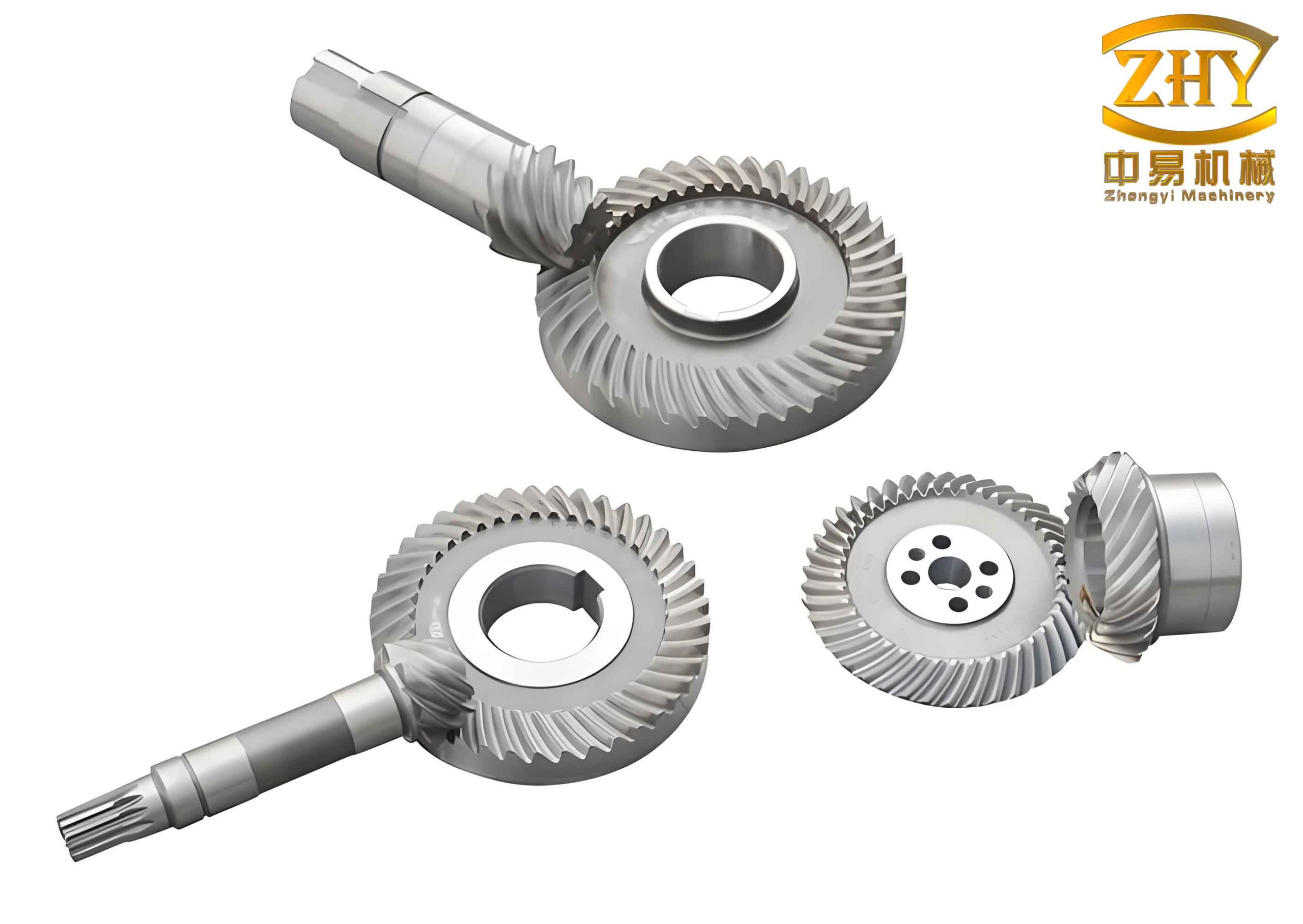
To understand the impact of lapping, we first examine the contact pattern and transmission error (TE) of hyperboloid gears. The contact pattern, visualized by applying a marking compound like Prussian blue or white lead paste to the gear teeth and performing a roll test, indicates the area of tooth contact. Post-heat treatment, distortions often lead to smaller, irregular contact patterns, concentrating stress and risking wear, pitting, or fatigue failure. Lapping expands and centralizes this pattern, distributing load more evenly and extending gear life. The transmission error, defined as the deviation between the theoretical and actual angular positions of the driven gear, is a direct measure of meshing smoothness. It is mathematically expressed as:
$$ TE(\theta) = \theta_{output} – \frac{N_{input}}{N_{output}} \cdot \theta_{input} $$
where \( TE(\theta) \) is the transmission error as a function of angular position, \( \theta_{output} \) is the actual output angle, \( \theta_{input} \) is the input angle, and \( N_{input}/N_{output} \) is the gear ratio. Minimizing TE is crucial for reducing gear noise, as it correlates with vibrational excitations. Lapping effectively reduces TE amplitudes, as demonstrated in pre- and post-lapping measurements.
Additionally, tooth thickness changes due to lapping are minimal but noteworthy. For instance, in a typical hyperboloid gear set, lapping might reduce pinion tooth thickness by approximately 30 μm and gear tooth thickness by 17 μm, which is negligible relative to design tolerances but contributes to optimal meshing clearance. This underscores lapping’s role as a precision correction rather than a bulk material removal process.
The following table summarizes the effects of lapping on key parameters for a sample hyperboloid gear set:
| Parameter | Pre-Lapping Value | Post-Lapping Value | Improvement |
|---|---|---|---|
| Contact Pattern Area (mm²) | 45.2 | 68.7 | +52% |
| Transmission Error Peak (μrad) | 43.5 | 26.7 | -39% |
| Surface Roughness Ra (μm) | 0.8 | 0.2 | -75% |
| Pinion Tooth Thickness Reduction (μm) | 0 | 31.2 | N/A |
| Gear Tooth Thickness Reduction (μm) | 0 | 17.1 | N/A |
The adjustment of H-coordinate (horizontal axis) during lapping significantly influences the contact pattern location on the tooth face of hyperboloid gears. The H-coordinate corresponds to the lateral displacement of the pinion relative to the gear, affecting the meshing position. In standard mounting, the pinion mounting distance (PMD) is defined as the distance from the pinion face to the gear center. Variations in PMD or H-coordinate shift the contact pattern across the tooth profile. The relationship can be described as follows:
- Increasing H (or PMD): On the convex side of the hyperboloid gear tooth, the contact pattern moves toward the toe (small end) and top; on the concave side, it moves toward the heel (large end) and top.
- Decreasing H (or PMD): On the convex side, the pattern shifts toward the heel and root; on the concave side, it shifts toward the toe and root.
This directional movement allows for precise tuning during lapping to correct heat treatment-induced pattern deviations. The effect of H-coordinate on TE is also critical. For instance, when V-coordinate (vertical axis) is held constant at zero, varying H alters the TE values, particularly the first harmonic (CM01) and second harmonic (CM02) components, which are key indicators of meshing performance. The optimization aims to keep CM01 below 30 μrad and CM02 below 10 μrad for optimal NVH.
To illustrate, consider experimental data from a hyperboloid gear set lapped under different H-coordinate settings, with TE measured on the coast side (non-drive side). The following table presents TE values for CM01 and CM02 across H variations from -0.1 mm to +0.1 mm:
| H State (mm) | CM01 (μrad) | CM02 (μrad) |
|---|---|---|
| -0.10 | 43.46 | 3.776 |
| -0.05 | 36.06 | 4.028 |
| 0.00 | 29.79 | 4.068 |
| +0.05 | 26.74 | 3.628 |
| +0.10 | 24.81 | 3.414 |
In this case, at H = 0 mm, CM01 is 29.79 μrad, which is near the threshold. To achieve better performance, the H-coordinate is adjusted to -0.1 mm during lapping, resulting in improved TE values as shown below:
| H State (mm) | CM01 (μrad) | CM02 (μrad) |
|---|---|---|
| -0.10 | 26.70 | 5.235 |
| -0.05 | 22.80 | 4.493 |
| 0.00 | 20.90 | 3.290 |
| +0.05 | 20.96 | 2.657 |
| +0.10 | 19.27 | 1.456 |
This demonstrates that strategic H-coordinate adjustments can effectively reduce TE, with CM01 falling below 30 μrad across all states post-optimization. The mathematical relationship between H-coordinate and TE can be approximated by a polynomial fit. For instance, for CM01 as a function of H, we might have:
$$ CM01(H) = aH^2 + bH + c $$
where \( a \), \( b \), and \( c \) are coefficients derived from experimental data. Minimizing this function helps identify the optimal H setting for lapping hyperboloid gears.
Beyond H-coordinate, other parameters like lapping time, torque, and abrasive concentration play vital roles. The lapping process can be modeled using wear equations. The material removal rate (MRR) during lapping of hyperboloid gears is often described by Preston’s equation:
$$ MRR = k \cdot P \cdot v $$
where \( MRR \) is the material removal rate, \( k \) is a constant dependent on abrasive and material properties, \( P \) is the pressure (related to applied torque), and \( v \) is the relative velocity between gear teeth. Integrating this over lapping time \( t \) gives the total removal \( \Delta z \):
$$ \Delta z = \int_0^t k \cdot P(t) \cdot v(t) \, dt $$
This removal influences tooth micro-geometry, correcting errors in profile and lead. For hyperboloid gears, the complex tooth geometry requires precise control over these parameters to avoid over-lapping or under-lapping.
The lapping cycle typically involves multiple stages: a roughing stage with higher torque and coarser abrasive to correct major distortions, followed by a finishing stage with lower torque and finer abrasive to improve surface finish. The cycle can be optimized using design of experiments (DOE) methods. Key factors include:
- Lapping Time: Longer times increase material removal but risk over-correction. Typically, 2-5 minutes per gear set is effective.
- Torque: Applied load affects pressure P; common range is 10-50 Nm for automotive hyperboloid gears.
- Abrasive Grain Size: Coarse grains (e.g., 100 μm) for rapid correction, fine grains (e.g., 10 μm) for finishing.
- V/H/G Coordinates: These define the meshing path; programming multiple coordinate sets ensures full tooth coverage.
A comprehensive parameter table for hyperboloid gear lapping might look like this:
| Parameter | Typical Range | Effect on Hyperboloid Gears |
|---|---|---|
| Lapping Time (min) | 2-10 | Increase reduces TE but may thin teeth excessively |
| Torque (Nm) | 10-50 | Higher torque accelerates correction but can increase heat |
| Abrasive Concentration (%) | 20-40 | Higher concentration increases MRR but may reduce finish |
| Rotational Speed (rpm) | 50-200 | Higher speed improves uniformity but increases wear rate |
| H-Coordinate Adjustment (mm) | ±0.2 | Shifts contact pattern; critical for TE optimization |
| V-Coordinate Adjustment (mm) | ±0.1 | Affects tooth depth engagement; fine-tunes pattern |
| G-Coordinate Adjustment (°) | ±0.5 | Adjusts gear angle; influences spiral angle correction |
The benefits of lapping extend beyond TE reduction. For hyperboloid gears, improved contact patterns enhance load distribution, which can be quantified by the contact stress formula based on Hertzian theory:
$$ \sigma_c = \sqrt{\frac{F}{\pi \cdot \left(\frac{1-\nu_1^2}{E_1} + \frac{1-\nu_2^2}{E_2}\right) \cdot \frac{1}{R}}} $$
where \( \sigma_c \) is the maximum contact stress, \( F \) is the normal load, \( \nu_1, \nu_2 \) are Poisson’s ratios, \( E_1, E_2 \) are Young’s moduli, and \( R \) is the effective radius of curvature. By enlarging the contact area through lapping, the stress \( \sigma_c \) decreases, reducing the risk of pitting and extending the fatigue life of hyperboloid gears. The fatigue life \( N_f \) can be estimated using the S-N curve relationship:
$$ N_f = C \cdot \sigma_c^{-m} $$
where \( C \) and \( m \) are material constants. Thus, lapping indirectly boosts durability.
Noise reduction is another critical outcome. Gear noise is often correlated with TE fluctuations, particularly higher harmonics. The sound pressure level (SPL) in decibels can be modeled as:
$$ SPL = 20 \log_{10}\left(\frac{p}{p_0}\right) $$
where \( p \) is the sound pressure from gear vibrations, and \( p_0 \) is the reference pressure. Reducing TE amplitudes through lapping decreases \( p \), thereby lowering SPL. Experimental studies on hyperboloid gears show that lapping can reduce noise by 3-5 dB in typical automotive applications.
To achieve consistent results, process monitoring is essential. In-line sensors can measure torque, temperature, and vibration during lapping, feeding data to adaptive control systems. For instance, a PID controller can adjust H-coordinate in real-time based on TE feedback from a roll tester integrated with the lapping machine. The control law might be:
$$ H(t) = K_p \cdot e(t) + K_i \int_0^t e(\tau) \, d\tau + K_d \frac{de(t)}{dt} $$
where \( e(t) \) is the error between target TE and measured TE, and \( K_p, K_i, K_d \) are tuning gains. This automation ensures each hyperboloid gear set meets stringent quality standards.
Furthermore, the lapping process must be tailored to specific hyperboloid gear designs, such as those used in differentials or power take-offs. Factors like gear ratio, module, and offset influence the optimal parameters. For high-offset hyperboloid gears common in automotive rear axles, the lapping path may require more complex V/H/G sequences to cover the highly curved tooth surfaces. Computational simulations using finite element analysis (FEA) or multi-body dynamics can predict lapping outcomes and reduce trial-and-error. The tooth surface geometry of a hyperboloid gear can be represented parametrically. For example, using Gleason’s generation method, the surface coordinates are given by:
$$ x = r \cos(\theta) + \delta \sin(\theta), \quad y = r \sin(\theta) – \delta \cos(\theta), \quad z = f(\theta, \phi) $$
where \( r \) is the pitch radius, \( \theta \) is the rotation angle, \( \delta \) is the offset, and \( \phi \) is the machine setting angle. Lapping modifies this surface minimally, correcting deviations \( \Delta x, \Delta y, \Delta z \) caused by heat treatment.
In practice, statistical process control (SPC) is employed to maintain lapping quality. Control charts for TE and contact pattern area help detect drifts. For example, an X-bar chart for CM01 might have upper and lower control limits calculated from historical data:
$$ UCL = \bar{X} + A_2 \bar{R}, \quad LCL = \bar{X} – A_2 \bar{R} $$
where \( \bar{X} \) is the sample mean, \( \bar{R} \) is the sample range, and \( A_2 \) is a constant. This ensures the lapping process for hyperboloid gears remains stable over production runs.
Looking ahead, advancements in lapping technology for hyperboloid gears include the use of ultrasonic-assisted lapping, which enhances material removal efficiency, and eco-friendly abrasive formulations. Moreover, integration with Industry 4.0 enables predictive maintenance of lapping machines, reducing downtime. The ultimate goal is to achieve “zero-defect” manufacturing of hyperboloid gears, where lapping plays a indispensable role.
In conclusion, the lapping process for hyperboloid gears is a sophisticated technique that significantly enhances gear performance by improving contact patterns, reducing transmission error, and lowering noise. Through careful adjustment of parameters like H-coordinate, torque, and time, coupled with mathematical modeling and experimental optimization, manufacturers can produce high-quality hyperboloid gears that meet the demands of modern automotive transmissions. As the industry moves towards quieter and more durable vehicles, mastering hyperboloid gear lapping will remain a key competitive advantage, driving innovation in gear manufacturing processes.