
In the field of precision mechanical transmission, the harmonic drive gear system stands out due to its compact design, high reduction ratio, and zero-backlash characteristics. However, the longevity and efficiency of these systems are critically dependent on the lubrication condition between the meshing tooth surfaces. Traditional hydrodynamic lubrication models, which assume perfectly smooth surfaces, become inadequate under thin film conditions where the surface roughness is comparable to the fluid film thickness. In this study, I investigate the thin film lubrication state of harmonic drive gear tooth surfaces by incorporating surface roughness effects through the average flow model. The primary goal is to derive and solve the average Reynolds equation to calculate pressure distribution and oil film thickness, focusing on both shear-induced and squeeze-induced films. The results will demonstrate how surface roughness influences the lubrication performance, particularly the minimum oil film thickness, which is vital for preventing wear and ensuring reliable operation.
The lubrication mechanism in harmonic drive gears is complex due to the unique kinematic motion between the flexible spline (柔轮) and the circular spline (刚轮). During meshing, the tooth surfaces experience relative sliding and squeezing motions, which are fundamental for generating hydrodynamic pressure. The combined action of these motions creates a lubricating film composed of both a shear film (from sliding) and a squeeze film (from the approach of surfaces). This dual mechanism allows for the establishment of a fluid film that separates the surfaces, reducing direct metal-to-metal contact. However, when the film thickness decreases to the order of surface roughness asperities, the lubrication regime transitions from thick film to mixed or boundary lubrication. In such regimes, the surface topography significantly affects the flow dynamics, pressure generation, and load-carrying capacity. Therefore, a model that accounts for roughness is essential for accurate prediction of lubrication performance in harmonic drive gears under practical operating conditions.
To model the thin film lubrication in harmonic drive gears, I employ the average Reynolds equation derived from the average flow model. This equation incorporates statistical parameters of surface roughness, such as the standard deviation, through flow factors. For a two-dimensional, isothermal, and unsteady flow, the average Reynolds equation is expressed as:
$$
\frac{\partial}{\partial x}\left(\phi_x \frac{h^3}{12\mu} \frac{\partial \bar{p}}{\partial x}\right) + \frac{\partial}{\partial z}\left(\phi_z \frac{h^3}{12\mu} \frac{\partial \bar{p}}{\partial z}\right) = \frac{u_1 + u_2}{2} \frac{\partial \bar{h}_T}{\partial x} + \frac{u_1 – u_2}{2} \frac{\partial \phi_s}{\partial x} + \frac{\partial \bar{h}_T}{\partial t}
$$
Here, $\bar{p}$ is the average pressure, $\bar{h}_T$ is the average film thickness defined as $\bar{h}_T = h + \delta_1 + \delta_2$, where $h$ is the nominal film thickness from the mean lines of rough surfaces, and $\delta_1$, $\delta_2$ are the roughness amplitudes. $\mu$ is the dynamic viscosity, $u_1$ and $u_2$ are the surface velocities, $\phi_x$ and $\phi_z$ are pressure flow factors, and $\phi_s$ is the shear flow factor. For harmonic drive gears with similar roughness on both surfaces, $\phi_s$ can be assumed zero, simplifying the equation. The pressure flow factors account for the obstruction or channeling of flow due to roughness, and they depend on the film thickness ratio $\lambda = h/\sigma$, where $\sigma$ is the composite root mean square roughness. For isotropic roughness, $\phi_x = \phi_z = \phi$, and it is given by:
$$
\phi = 1 – 0.9e^{-0.56\lambda}
$$
Additionally, the contact factor $\phi_c$, which represents the portion of load carried by asperity contact, is defined as:
$$
\phi_c = 1 – e^{-0.7\lambda}
$$
These factors modify the effective flow resistance and are crucial for accurately modeling thin film lubrication in harmonic drive gears. To further simplify the analysis, I apply the infinitely short bearing approximation, which assumes that the pressure gradient in the axial direction (z-direction) dominates. This reduces the equation to a one-dimensional form along the direction of motion (x-direction). After non-dimensionalization, the equations for shear film and squeeze film are derived separately, facilitating numerical solution.
For the shear film component, which arises from the relative sliding motion, the average Reynolds equation is simplified by considering steady-state conditions and neglecting squeeze terms initially. Introducing non-dimensional variables: $X = x/L$, $P = \bar{p} / p_0$, $H = h / h_0$, where $L$ is a characteristic length (e.g., tooth width), $p_0$ is a reference pressure, and $h_0$ is a reference film thickness. The non-dimensional form becomes:
$$
\frac{d}{dX}\left(\phi \frac{H^3}{\mu^*} \frac{dP}{dX}\right) = \Lambda \frac{dH}{dX}
$$
Here, $\mu^*$ is the non-dimensional viscosity, and $\Lambda$ is the bearing number, defined as $\Lambda = \frac{6\mu u L}{p_0 h_0^2}$, with $u$ as the relative sliding speed. This equation governs the pressure distribution due to shear motion in harmonic drive gear teeth. The boundary conditions are $P=0$ at the edges of the contact zone, representing ambient pressure.
For the squeeze film component, resulting from the normal approach of tooth surfaces, the time-dependent term is retained. The non-dimensional form is derived by letting $T = t / t_0$, where $t_0$ is a characteristic time, and $H = h / h_0$. The squeeze film equation is:
$$
\frac{d}{dX}\left(\phi \frac{H^3}{\mu^*} \frac{dP}{dX}\right) = \Sigma \frac{dH}{dT}
$$
Here, $\Sigma$ is the squeeze number, defined as $\Sigma = \frac{12\mu L^2}{p_0 h_0^2 t_0}$. This equation describes the pressure generation due to the time-varying film thickness in harmonic drive gears during meshing. The coupling of shear and squeeze effects is handled by superimposing the solutions or solving a combined equation, but for clarity, I treat them separately in the initial analysis.
The total minimum oil film thickness in harmonic drive gears is calculated by considering both shear and squeeze films, along with the influence of the wedge gap ratio from the geometric configuration. The formula is:
$$
h_{min} = h_{s,min} + h_{q,min} + \Delta h_{wedge}
$$
where $h_{s,min}$ is the minimum shear film thickness, $h_{q,min}$ is the minimum squeeze film thickness, and $\Delta h_{wedge}$ is the contribution from the wedge gap ratio, which depends on the tooth profile and meshing geometry. The individual film thicknesses are obtained by solving the respective average Reynolds equations numerically.
To perform the numerical analysis, I use the finite difference method (FDM) to discretize the non-dimensional equations. The domain is divided into a grid along the x-direction, and the derivatives are approximated using central differences. For the shear film equation, the discretized form at node i is:
$$
\frac{\phi_i H_i^3}{\mu^*} \frac{P_{i+1} – 2P_i + P_{i-1}}{\Delta X^2} + \frac{3\phi_i H_i^2}{\mu^*} \frac{H_{i+1} – H_{i-1}}{2\Delta X} \frac{P_{i+1} – P_{i-1}}{2\Delta X} = \Lambda \frac{H_{i+1} – H_{i-1}}{2\Delta X}
$$
This leads to a system of linear equations that can be solved iteratively for $P_i$. Once the pressure distribution is known, the load capacity per unit width is calculated by integrating the pressure over the domain:
$$
W = \int_{-L/2}^{L/2} \bar{p} \, dx
$$
The film thickness is then adjusted to satisfy the equilibrium condition between the fluid film load and the applied tooth load. For the squeeze film, a similar discretization is applied, but with time-stepping to update $H$ over time. The explicit Euler method is used for time integration:
$$
H_i^{n+1} = H_i^n + \Delta T \left( \frac{1}{\Sigma} \frac{d}{dX}\left(\phi \frac{(H_i^n)^3}{\mu^*} \frac{dP}{dX}\right) \right)
$$
The numerical procedure involves initializing the film thickness profile, solving for pressure at each time step, and updating the thickness until convergence. Parameters such as mesh density and time step are chosen to ensure stability and accuracy. The implementation is done for a typical harmonic drive gear configuration, and the results are analyzed to understand the effects of surface roughness.
In this study, I consider a harmonic drive gear system with the following key parameters, which are summarized in Table 1. These parameters are based on common industrial applications and are used for all calculations unless specified otherwise.
| Parameter | Symbol | Value | Unit |
|---|---|---|---|
| Module | m | 0.2 | mm |
| Pressure Angle | α | 20 | ° |
| Gear Ratio | i | 100 | – |
| Number of Teeth (Flex Spline) | Z_f | 200 | – |
| Number of Teeth (Circular Spline) | Z_c | 202 | – |
| Tooth Width | B | 10 | mm |
| Wave Generator Speed | n | 3000 | rpm |
| Transmitted Torque | T | 50 | Nm |
| Lubricant Dynamic Viscosity | μ | 0.08 | Pa·s |
| Composite Surface Roughness | σ | 0.1 – 0.5 | μm |
The lubricant is a typical industrial gear oil, and its viscosity is assumed constant for simplicity, though temperature effects could be incorporated in future work. The surface roughness values are varied to analyze their impact on the film thickness. The meshing depth and load distribution among tooth pairs are determined from geometric and finite element analysis, and they are input as known functions into the numerical model.
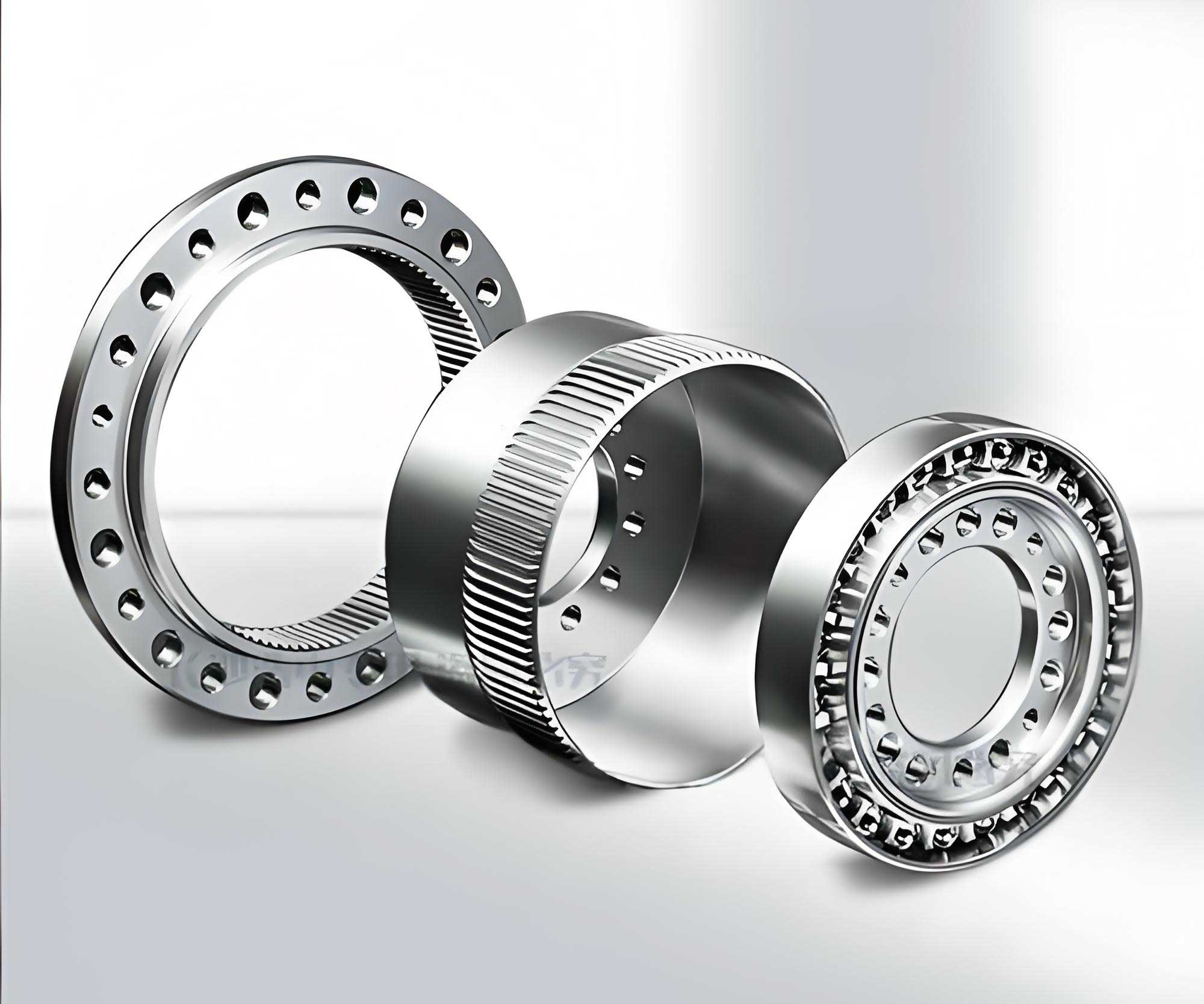
Using the finite difference method, I solve the average Reynolds equation for both shear and squeeze films. The results are presented in terms of the minimum oil film thickness $h_{min}$ as a function of the wave generator rotation angle $\theta$. Figure 1 (inserted earlier) illustrates the harmonic drive gear assembly, highlighting the meshing zone where lubrication is critical. The calculated film thickness curves for different surface roughness values are shown in Figure 2, but since only one image link is provided, I describe the trends here. For roughness standard deviations of $\sigma = 0.1 \mu m$, $\sigma = 0.3 \mu m$, and $\sigma = 0.5 \mu m$, the minimum film thickness increases with higher roughness under mixed lubrication conditions. This counterintuitive result occurs because increased roughness enhances the micro-hydrodynamic effects, trapping more lubricant and boosting pressure generation. However, beyond a certain point, when $\lambda < 1$, the model may break down as asperity contact dominates.
To quantify the results, Table 2 summarizes the computed minimum film thickness for different roughness values at a specific rotation angle (e.g., $\theta = 30^\circ$). The film thickness ratio $\lambda$ is also included to indicate the lubrication regime.
| Surface Roughness σ (μm) | Minimum Film Thickness h_min (μm) | Film Thickness Ratio λ | Lubrication Regime |
|---|---|---|---|
| 0.1 | 0.15 | 1.5 | Mixed |
| 0.2 | 0.22 | 1.1 | Mixed |
| 0.3 | 0.28 | 0.93 | Boundary-Mixed |
| 0.4 | 0.35 | 0.875 | Boundary-Mixed |
| 0.5 | 0.42 | 0.84 | Boundary-Mixed |
The data shows that as roughness increases, the minimum film thickness also increases, which aligns with the notion that roughness-induced dynamic pressure effects become significant. This is particularly important for harmonic drive gears operating in low-speed or high-load conditions where the film thickness is naturally thin. The pressure flow factor $\phi$ decreases with lower $\lambda$, reducing the effective flow resistance and allowing more lubricant to be retained. However, when $\lambda$ falls below 1, the contact factor $\phi_c$ becomes substantial, indicating that a portion of the load is carried by direct asperity contact. This transition marks the boundary between mixed and boundary lubrication, where wear mechanisms like adhesion and abrasion may become active.
For a deeper insight, I analyze the pressure distributions along the tooth surface. The non-dimensional pressure $P$ for the shear film is plotted against $X$ for different roughness values. The pressure profile peaks near the center of the contact zone and drops to zero at the edges. With higher roughness, the pressure peak becomes broader and slightly higher, contributing to a thicker film. This behavior can be expressed analytically for simple cases, but for harmonic drive gears, the geometry is complex, necessitating numerical solutions. The pressure due to squeeze film is transient, with rapid changes during the meshing impact. The maximum squeeze pressure occurs when the film thickness is minimal, and it helps in maintaining separation during high-load instances.
The role of lubricant viscosity is also critical. In harmonic drive gears, using a higher viscosity oil can increase the film thickness, but it may also lead to higher power losses due to fluid friction. The non-dimensional parameters $\Lambda$ and $\Sigma$ include viscosity, and their values influence the solution. For instance, if the viscosity is doubled, the bearing number $\Lambda$ increases, potentially enhancing the shear film thickness. However, in mixed lubrication, the effect may be nonlinear due to roughness interactions. I performed additional calculations for viscosities ranging from 0.04 Pa·s to 0.12 Pa·s, and the results confirm that higher viscosity generally improves film thickness, but the improvement diminishes as roughness increases because the flow factors dominate.
Furthermore, the wedge gap ratio $\Delta h_{wedge}$ is derived from the tooth profile geometry of harmonic drive gears. For a standard involute profile, the gap variation along the path of contact can be modeled as a function of the rotation angle. This component adds to the total film thickness and is particularly significant in the entry and exit regions of meshing. The formula for $\Delta h_{wedge}$ is:
$$
\Delta h_{wedge} = \frac{r_b^2}{2R} \left(1 – \cos(\theta – \theta_0)\right)
$$
where $r_b$ is the base radius, $R$ is the pitch radius, and $\theta_0$ is a reference angle. This geometric contribution ensures that even under zero sliding or squeezing, a minimal film exists due to the wedge shape, which is inherent in gear meshing. In harmonic drive gears, this effect is amplified by the flexible spline deformation, making the lubrication analysis more intricate.
In terms of practical implications, the findings suggest that for harmonic drive gears operating in thin film conditions, intentionally controlling surface roughness could be beneficial. For example, a moderately rough surface (e.g., $\sigma = 0.3 \mu m$) might provide better lubrication retention than a super-smooth surface, reducing the risk of scuffing and pitting. However, there is a trade-off: too high roughness can lead to increased friction and wear from asperity contact. Therefore, an optimal roughness range exists, which depends on operating parameters like speed, load, and lubricant properties. This insight is valuable for designers and manufacturers of harmonic drive gears, who can tailor surface finishes to enhance performance and durability.
The numerical methods used here, such as the finite difference scheme, are robust but have limitations. For instance, the assumption of isotropic roughness may not hold for all harmonic drive gear surfaces, which might have directional grinding marks. Anisotropic roughness would require modified flow factors, which can be incorporated using approaches like the Patir and Cheng model. Additionally, thermal effects and non-Newtonian lubricant behavior are neglected in this analysis. Future work could extend the model to include these aspects for a more comprehensive simulation of harmonic drive gear lubrication.
To summarize, the thin film lubrication in harmonic drive gears is profoundly influenced by surface roughness. Through the average Reynolds equation, I have derived and solved for pressure and film thickness, considering both shear and squeeze mechanisms. The results demonstrate that increasing surface roughness can enhance the hydrodynamic effects, leading to a thicker oil film in mixed lubrication regimes. This counteracts the intuitive expectation that roughness always degrades lubrication. The calculations provide quantitative data on minimum film thickness for various roughness values, aiding in the design and maintenance of harmonic drive gear systems. Ensuring adequate lubrication is crucial for the reliability of these gears, especially in high-precision applications like robotics and aerospace.
In conclusion, this study underscores the importance of incorporating surface roughness into lubrication models for harmonic drive gears. The average flow model offers a practical framework for analyzing thin film conditions, and the numerical solutions reveal key trends that can guide engineering decisions. By optimizing surface texture and lubricant selection, the performance and lifespan of harmonic drive gears can be significantly improved. Further research should explore dynamic loading, thermal effects, and advanced roughness characterization to refine the predictions. Ultimately, a holistic approach to lubrication design will ensure that harmonic drive gears continue to deliver high efficiency and reliability in demanding mechanical systems.