
In the field of mechanical transmission, spiral bevel gears are widely used due to their high transmission efficiency, compact structure, and reliability. They are critical components in applications such as machine tools, automotive systems, ships, and aerospace engines. With the trend toward high-speed, heavy-load, and lightweight designs, the demands on gear performance and dynamic characteristics have increased significantly. Among various failure modes, such as pitting, gluing, tooth breakage, and rim fracture, the fracture caused by traveling wave resonance is particularly insidious and destructive, often leading to sudden catastrophic outcomes. In this study, I investigate the evolution of crack extension frequency characteristics in spiral bevel gears under traveling wave resonance conditions, combining experimental and numerical simulation approaches.
The phenomenon of traveling wave resonance in gears has been extensively studied. For rotating structures like disks and gears, traveling wave vibrations occur when forward and backward waves superimpose, leading to resonance under specific excitation frequencies. The condition for traveling wave resonance is given by the coincidence of excitation frequency with the natural frequencies of these waves. For a gear with m nodal diameters, the forward and backward wave frequencies in a stationary frame are expressed as:
$$f’_{f,b} = f \pm \frac{mn}{60}$$
where f is the natural frequency of the gear, n is the rotational speed in rpm, and the excitation frequency due to gear meshing is f_e = zn/60, with z being the number of teeth. Resonance occurs when f_e = f’_{f} or f_e = f’_{b}, leading to forward or backward traveling wave resonance, respectively. This theory forms the basis for analyzing the dynamic behavior of spiral bevel gears under operational conditions.
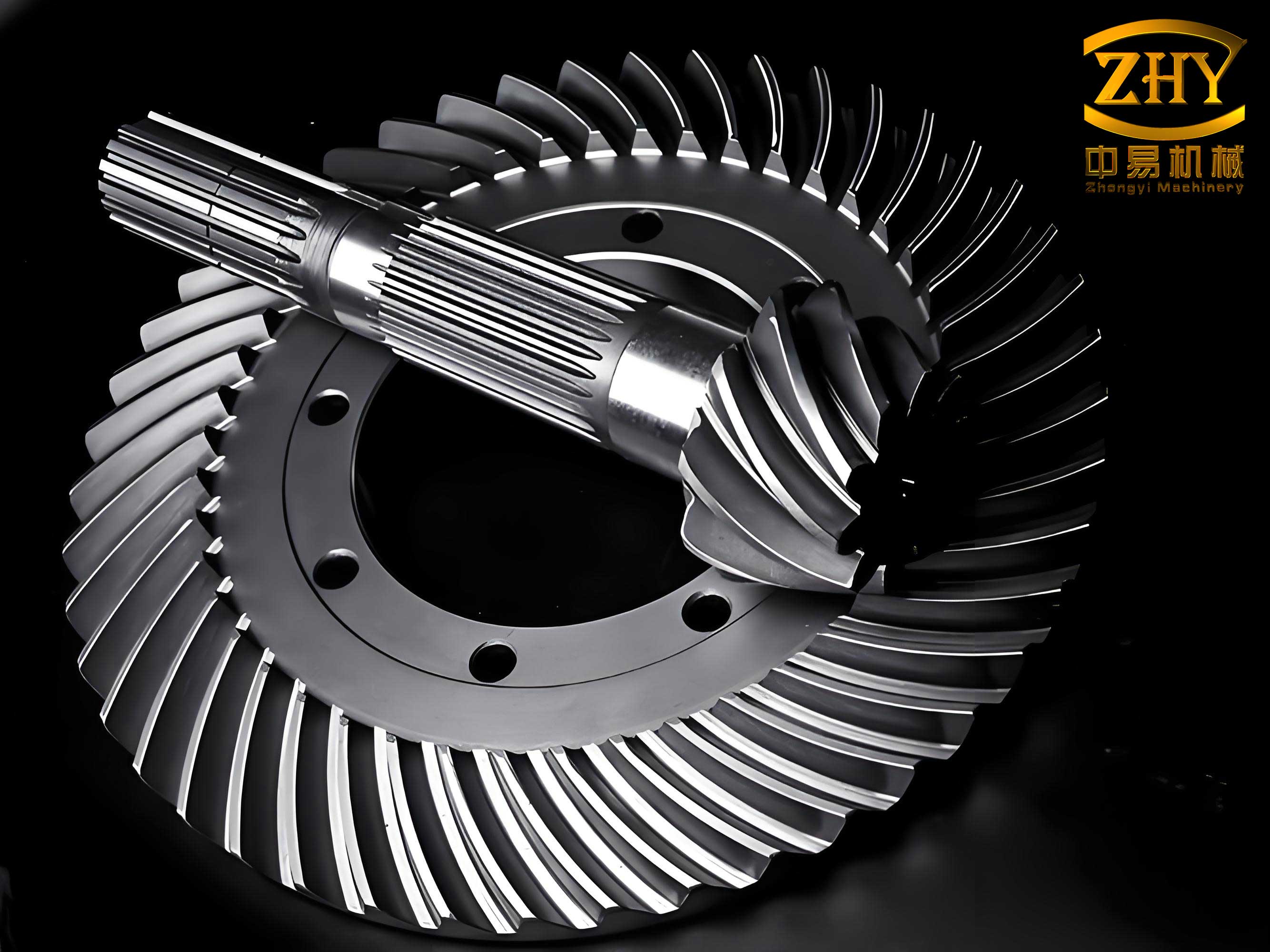
To understand the crack extension process in spiral bevel gears, experimental investigations were conducted on both normal and pre-defective gears. The experimental setup involved a central transmission spiral bevel gear system from an aero-engine, with noise monitoring using acoustic measurement methods. The gear parameters included a driven spiral bevel gear with 35 teeth and a driving gear with 47 teeth. The noise signals were captured via waveguides placed near the gear rim, allowing for precise tracking of resonance frequencies. The experimental procedure involved subjecting the gears to traveling wave resonance conditions by adjusting the rotational speed to match the predicted resonance points based on modal analysis.
The results from the experiments on normal spiral bevel gears indicated that under three-nodal-diameter forward traveling wave resonance and four-nodal-diameter backward traveling wave resonance, the gears endured fatigue cycles far exceeding design requirements without crack initiation. However, for spiral bevel gears with pre-existing defects, rapid crack extension was observed under resonance conditions. The resonance frequencies decreased progressively as the crack propagated, and in the later stages, it became impossible to track the resonance points, leading to instantaneous fracture. This behavior highlights the critical role of initial defects in the failure of spiral bevel gears under traveling wave resonance.
To complement the experimental findings, numerical simulations using finite element analysis were performed. Models of spiral bevel gears with varying crack scales were developed to simulate the crack extension process. The crack dimensions, including length and depth, were incrementally increased to represent different stages of propagation. Modal analysis was conducted to extract natural frequencies and mode shapes for both three-nodal-diameter and four-nodal-diameter vibrations. The simulation results revealed that as the crack deepens, the structural asymmetry of the spiral bevel gear increases, causing the two symmetric modes of the same nodal diameter vibration to diverge into distinct vibrational modes with different natural frequencies. This divergence is quantified by the modal frequency ratio, defined as:
$$\lambda = \frac{f_i}{f_0}$$
where f_i is the modal frequency at a given crack stage and f_0 is the modal frequency of the uncracked gear. The relationship between crack length and modal frequency ratio was analyzed, and a polynomial function was fitted to predict crack extension states in the early stages. For three-nodal-diameter vibrations, the function is:
$$\lambda^{(3)} = -3.457 \times 10^{-9} L^3 – 1.963 \times 10^{-5} L^2 + 1.115 \times 10^{-4} L + 0.99981$$
and for four-nodal-diameter vibrations:
$$\lambda^{(4)} = -8.279 \times 10^{-8} L^3 – 1.514 \times 10^{-5} L^2 + 5.574 \times 10^{-5} L + 0.99994$$
where L is the crack length in millimeters. These functions enable accurate prediction of crack states with relative errors below 0.02%, demonstrating their utility in monitoring spiral bevel gear health.
The evolution of modal frequencies with crack extension is summarized in the following tables, which provide data for different crack stages in spiral bevel gears. These tables illustrate the decrease in natural frequencies and the increasing divergence between symmetric modes as cracks propagate.
| Crack Stage | Three-Nodal-Diameter Modal Frequency (Hz) – Mode 1 | Three-Nodal-Diameter Modal Frequency (Hz) – Mode 2 |
|---|---|---|
| Normal | 8026.4 | 8053.7 |
| Stage 1 | 8027.0 | 8054.4 |
| Stage 2 | 8025.2 | 8052.0 |
| Stage 3 | 8020.0 | 8048.1 |
| Stage 4 | 8009.3 | 8043.3 |
| Stage 5 | 7989.7 | 8037.2 |
| Stage 6 | 7962.5 | 8029.8 |
| Stage 7 | 7927.6 | 8019.9 |
| Stage 8 | 7899.1 | 8011.2 |
| Stage 9 | 7866.2 | 8000.7 |
| Stage 10 | 7828.8 | 7988.1 |
| Crack Stage | Four-Nodal-Diameter Modal Frequency (Hz) – Mode 1 | Four-Nodal-Diameter Modal Frequency (Hz) – Mode 2 |
|---|---|---|
| Normal | 13380 | 13380 |
| Stage 1 | 13380 | 13380 |
| Stage 2 | 13374 | 13380 |
| Stage 3 | 13359 | 13378 |
| Stage 4 | 13334 | 13374 |
| Stage 5 | 13298 | 13367 |
| Stage 6 | 13249 | 13355 |
| Stage 7 | 13193 | 13339 |
| Stage 8 | 13146 | 13324 |
| Stage 9 | 13095 | 13307 |
| Stage 10 | 13039 | 13286 |
The data clearly show that for spiral bevel gears, the modal frequencies decrease with crack extension, and the difference between the two symmetric modes becomes more pronounced, especially in the later stages. This asymmetry disrupts the stability of traveling wave resonance, making it difficult to maintain resonance conditions and leading to rapid fracture.
In the early stages of crack extension, traveling wave resonance in spiral bevel gears causes high stress intensity factors at the crack tip, promoting crack growth. As the crack propagates, the structural asymmetry increases, and the two symmetric modes alternate, preventing the gear from sustaining resonance. Consequently, the stress intensity factor approaches or exceeds the material’s fracture toughness, resulting in rapid crack extension and insufficient residual strength, leading to instantaneous breakage. This mechanism is critical for understanding the failure of spiral bevel gears in high-speed applications.
To further analyze the crack extension behavior, the stress distribution in spiral bevel gears was examined through finite element simulations. The maximum stress ratio, defined as the stress at the crack tip relative to a reference point, was used to assess the severity of stress concentrations. For three-nodal-diameter vibrations, the maximum stress ratio was approximately 10.33, while for four-nodal-diameter vibrations, it was about 33.74. These values indicate that four-nodal-diameter resonance induces higher stress concentrations, making spiral bevel gears more susceptible to crack initiation and propagation under such conditions.
The crack extension paths in spiral bevel gears were also simulated, revealing two primary directions: from the tooth root along the web toward the central axis and from the small end along the tooth root toward the large end. The crack stages were divided into four processes (P1 to P4), with endpoints defined from S0 to S4. The crack dimensions at each stage are provided in the following tables, which summarize the length and depth increments for both three-nodal-diameter and four-nodal-diameter crack extensions in spiral bevel gears.
| Crack Stage | Crack Length L (mm) | Crack Depth H (mm) |
|---|---|---|
| Stage 1 | 1.84 | 0.6 |
| Stage 2 | 5.43 | 1.76 |
| Stage 3 | 9.02 | 2.92 |
| Stage 4 | 12.58 | 4.07 |
| Stage 5 | 16.19 | 5.23 |
| Stage 6 | 19.18 | 6.39 |
| Stage 7 | 23.43 | 7.55 |
| Stage 8 | 27.37 | 8.35 |
| Stage 9 | 31.31 | 9.15 |
| Stage 10 | 35.25 | 9.95 |
| Crack Stage | Crack Length L (mm) | Crack Depth H (mm) |
|---|---|---|
| Stage 1 | 1.84 | 0.6 |
| Stage 2 | 5.43 | 1.76 |
| Stage 3 | 9.02 | 2.92 |
| Stage 4 | 12.67 | 4.08 |
| Stage 5 | 16.42 | 5.24 |
| Stage 6 | 20.18 | 6.4 |
| Stage 7 | 23.94 | 7.55 |
| Stage 8 | 29.44 | 8.35 |
| Stage 9 | 34.95 | 9.15 |
| Stage 10 | 40.46 | 9.95 |
These tables facilitate the monitoring of crack progression in spiral bevel gears and provide insights into the relationship between crack geometry and dynamic response. The use of such data is essential for predictive maintenance and fault diagnosis in gear systems.
In conclusion, this study demonstrates that traveling wave resonance significantly influences the crack extension behavior in spiral bevel gears. Through experimental and numerical analyses, I have shown that normal spiral bevel gears can withstand resonance conditions without failure, whereas gears with pre-existing defects experience rapid crack growth. The evolution of resonance frequencies and modal characteristics provides valuable indicators for crack monitoring. The proposed functions for modal frequency ratio versus crack length enable accurate prediction of early-stage crack extension in spiral bevel gears. These findings contribute to the understanding of failure mechanisms in high-speed gear transmissions and offer practical tools for enhancing the reliability and safety of spiral bevel gears in critical applications.
Future work could focus on real-time monitoring systems for spiral bevel gears, integrating acoustic and vibration sensors to detect resonance shifts and crack initiation. Additionally, advanced materials and design modifications could be explored to mitigate traveling wave resonance effects in spiral bevel gears. By addressing these challenges, the performance and lifespan of spiral bevel gears in demanding environments can be significantly improved.