
In the domain of mechanical power transmission, gears stand as fundamental components whose reliable performance is paramount to the integrity of countless systems, from automotive drivetrains to industrial machinery. Among the various failure modes that plague gears, contact fatigue, manifesting primarily as pitting and spalling on the active tooth flanks, is a predominant life-limiting factor. While design parameters, material selection, and lubrication are crucial, the final arbiter of a gear’s resistance to this cyclic subsurface stressing is often its metallurgical state, meticulously crafted through heat treatment. This process, however, is a double-edged sword. When executed optimally, it creates a hard, wear-resistant case with a tough, ductile core, dramatically enhancing load-bearing capacity. Conversely, deviations or suboptimal protocols can introduce a spectrum of heat treatment defects that serve as potent nucleation sites for fatigue cracks, catastrophically undermining the component’s projected lifespan. My exploration here delves into the intricate relationship between heat treatment methodologies, the latent heat treatment defects they may harbor, and the resultant contact fatigue performance, employing analytical frameworks and empirical data to elucidate the path toward superior gear durability.
The pursuit of quantifying gear contact fatigue strength has led to the development of standardized testing methodologies, such as the conventional group test method and the more expedient Locati (or staircase) rapid test method. The latter, grounded in the Palmgren-Miner linear cumulative damage hypothesis, offers a practical balance between reliability and resource efficiency. It operates on the principle that the total damage at failure is the sum of the fractional damages incurred at different stress levels. Mathematically, if a component undergoes \( n_i \) cycles at a stress level \( S_i \), and \( N_i \) is the number of cycles to failure at that same stress level (derived from a reference S-N curve), failure is predicted when:
$$
\sum \frac{n_i}{N_i} = 1
$$
The Locati method applies this by subjecting a single gear pair to sequentially increased stress levels until failure, using a predefined reference S-N curve for interpolation to find the fatigue limit stress \( \sigma_{H\lim} \) corresponding to the cumulative sum of 1. This method’s validity hinges on possessing a reliable reference curve, often available in standards like ISO 6336 (GB/T 3480), making it particularly suitable for evaluating the performance of common materials like case-hardened steels under different processing conditions.
The Metallurgical Crucible: Heat Treatment and Its Inherent Defects
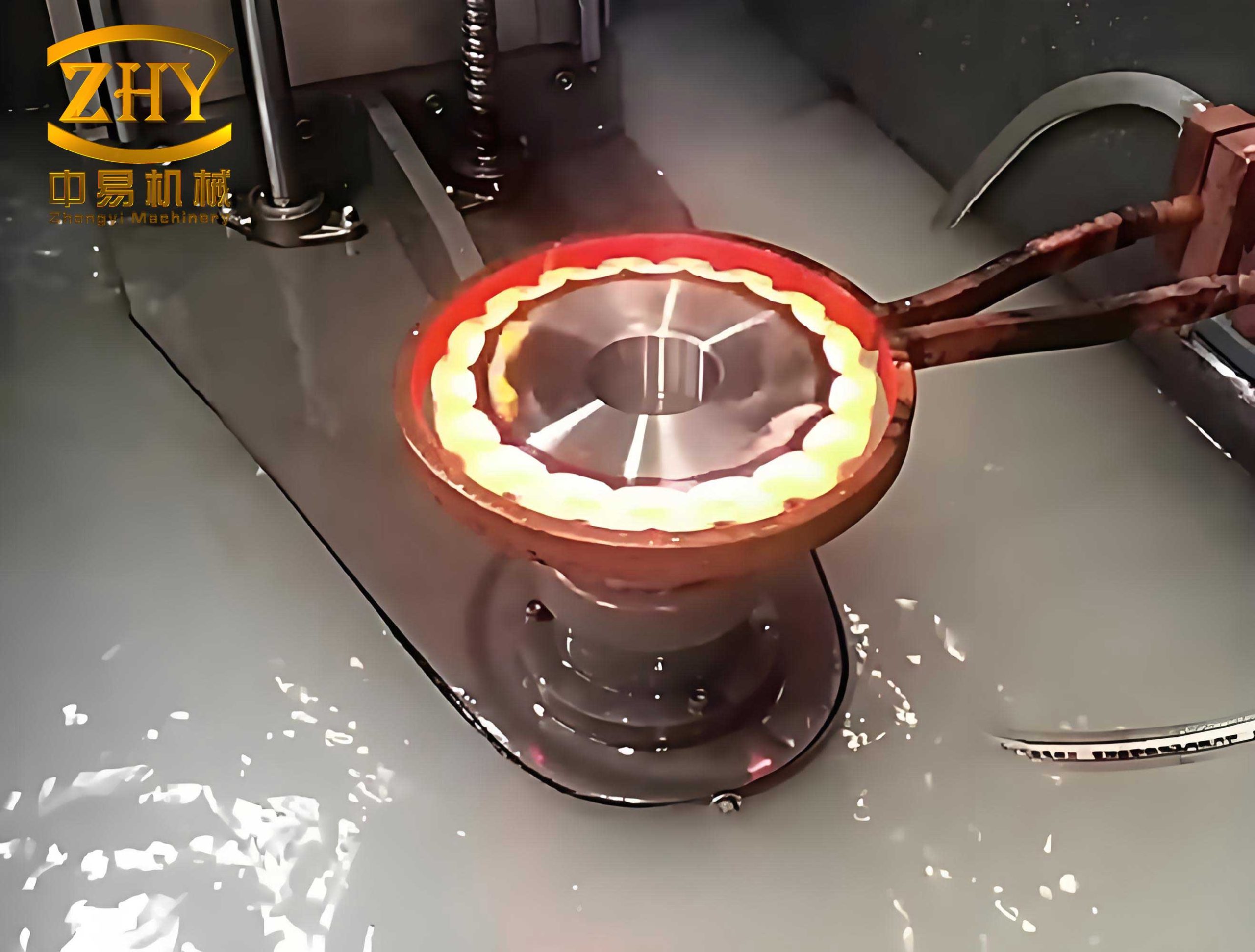
Heat treatment for high-performance gears, particularly carburizing or carbonitriding followed by quenching and tempering, is designed to achieve a specific gradient in properties. The goal is a high-surface hardness (58-64 HRC) for resistance to pitting and wear, supported by a core with good strength and toughness to withstand bending loads. However, the complex thermal and thermochemical cycles involved are fertile ground for heat treatment defects. These defects can be broadly categorized as follows:
| Category of Defect | Specific Manifestations | Primary Causes | Impact on Contact Fatigue |
|---|---|---|---|
| Microstructural Anomalies | Excessive retained austenite, coarse martensite, non-martensitic transformation products (e.g., bainite, ferrite) in the case, decarburization. | Incorrect carbon potential, low quenching speed, inadequate tempering, improper atmosphere control. | Reduces surface hardness and yield strength, lowers resistance to crack initiation. Soft phases act as stress concentrators. |
| Stress/Geometry-Based Defects | Quenching distortions, cracking, excessive residual tensile stresses at the surface. | Non-uniform cooling, part geometry, high thermal gradients. | Distortion affects load distribution. Cracks are direct fatigue starters. Tensile stresses superimpose on contact loads, lowering fatigue limit. |
| Surface Integrity Issues | Oxidation, intergranular oxidation (IGO), grain boundary etching, micro-pitting from improper finishing post-heat treat. | Uncontrolled furnace atmosphere, impurities, inadequate cleaning before heat treatment. | Creates notches and weak boundaries at the surface, facilitating early crack initiation under cyclic shear stresses. |
Among these, excessive retained austenite and intergranular oxidation are particularly pernicious heat treatment defects for contact fatigue. Retained austenite, a metastable phase, is softer and can undergo strain-induced transformation under contact loading, leading to dimensional instability and micro-cracking. IGO, a form of subsurface oxidation along prior austenite grain boundaries, severely weakens the cohesive strength of the material just below the surface—precisely where the maximum orthogonal shear stress occurs in Hertzian contact. These defects effectively lower the intrinsic fatigue strength of the material, meaning that even a perfectly designed gear will succumb prematurely if such flaws are present.
Mechanisms of Contact Fatigue Initiation from Defects
The classical theory for gear contact stress is based on Hertzian analysis. The maximum contact pressure \( p_0 \) between two cylindrical surfaces (analogous to gear teeth) is given by:
$$
p_0 = \sqrt{\frac{F}{\pi L} \cdot \frac{\frac{1}{R_1} + \frac{1}{R_2}}{\frac{1-\nu_1^2}{E_1} + \frac{1-\nu_2^2}{E_2}}}
$$
Where \( F \) is the normal load, \( L \) is the face width, \( R \) are the radii of curvature, and \( E \) and \( \nu \) are the Young’s modulus and Poisson’s ratio of the mating materials. For gears, this is adapted using application factors as per ISO 6336:
$$
\sigma_H = Z_E Z_H Z_{\epsilon} Z_{\beta} \sqrt{\frac{F_t}{d_1 b} \frac{u \pm 1}{u}}
$$
Where \( \sigma_H \) is the contact stress, \( Z_E \) is the elasticity factor, \( Z_H \) is the zone factor, \( Z_{\epsilon} \) is the contact ratio factor, \( Z_{\beta} \) is the helix angle factor, \( F_t \) is the tangential load, \( d_1 \) is the pinion reference diameter, \( b \) is the facewidth, and \( u \) is the gear ratio.
Subsurface, the stress field generates cyclical shear stresses. The maximum orthogonal shear stress \( \tau_{zy,max} \) occurs at a depth of approximately 0.786b (for Poisson’s ratio 0.3) below the surface, where b is the half-width of the contact patch. Fatigue cracks typically initiate at locations of maximum alternating shear stress, which can be at or slightly below the surface depending on the friction coefficient. Heat treatment defects located within this critical region drastically reduce the stress required to initiate a crack. A non-metallic inclusion, a cluster of retained austenite, or an IGO network acts as a stress concentrator, locally amplifying the applied shear stress. The relationship between the applied stress amplitude \( \Delta \sigma \) and the number of cycles to failure \( N_f \) is described by the Basquin equation:
$$
\Delta \sigma = \sigma_f’ (2N_f)^b
$$
Here, \( \sigma_f’ \) is the fatigue strength coefficient and \( b \) is the fatigue strength exponent. The presence of defects effectively reduces \( \sigma_f’ \) for the material at that specific location, shifting the S-N curve downward. This means that for an identical applied load, the component with heat treatment defects will accumulate damage at a faster rate per the Miner’s rule \( \sum (n_i/N_i) \), leading to a significantly lower observed fatigue limit \( \sigma_{H\lim} \) in testing.
Experimental Investigation: Applying the Locati Method to Compare Processes
To empirically demonstrate the impact of different heat treatment cycles, consider a test program modeled on the principles previously discussed. The test subject is a standard spur gear with the following parameters:
| Parameter | Value |
|---|---|
| Module (m) | 6.5 mm |
| Number of Teeth (Z1/Z2) | 25 / 24 |
| Pressure Angle (α) | 20° |
| Face Width (b) | 35 mm |
| Case Hardness Target | 58-62 HRC |
Two distinct heat treatment processes, denoted Process A and Process B, are applied to separate batches of gears manufactured from the same steel grade (e.g., a common carburizing steel like 20MnCr5). Process A represents an optimized cycle with precise atmosphere control, aggressive but uniform quenching, and appropriate tempering. Process B, while still within acceptable industrial norms, might involve a slightly lower quenching rate, a marginally higher carburizing temperature leading to coarser austenite grains, or less optimal atmosphere purity.
The test is conducted on a dedicated gear contact fatigue rig, using a controlled lubrication system. The failure criterion is defined as the point where the pitted area on a single tooth reaches 4% of its total contact area. The Locati rapid test method is employed. A reference S-N curve is selected from the MQ quality level in ISO 6336, with a baseline fatigue limit \( \sigma_{H\lim,ref} = 1500 \) MPa at \( N_L = 5 \times 10^7 \) cycles. The test starts at an initial stress \( \sigma_1 = 1450 \) MPa, with a stress increment \( \Delta \sigma = 100 \) MPa. At each level, the gear pair runs for a preset cycle count \( n = 5 \times 10^5 \) unless failure occurs earlier.
The core of the Locati analysis lies in calculating the cumulative damage for three hypothetical S-N curves: the reference curve (σHlim=1500 MPa), a lower-bound curve (σHlim=1400 MPa), and an upper-bound curve (σHlim=1600 MPa). The standard S-N curve formulation for contact fatigue often uses a high exponent. A common form is:
$$
\sigma^m \cdot N = C
$$
Where \( m \) is the slope exponent (e.g., around 13.22 for some data sets) and \( C \) is a constant. For a given stress level \( \sigma_i \) in the test, the number of cycles to failure \( N_i \) on each of the three reference curves is calculated. The partial damage at that level is \( n_i / N_i \). These are summed across all stress levels up to failure.
| Stress Level σ (MPa) | Cycles Run n | Ni for Curve A (1400 MPa) | Damage n/N (A) | Ni for Curve B (1500 MPa) | Damage n/N (B) | Ni for Curve C (1600 MPa) | Damage n/N (C) |
|---|---|---|---|---|---|---|---|
| 1450 | 5.00E+05 | 3.14E+07 | 0.0159 | 7.83E+07 | 0.0064 | 1.84E+08 | 0.0027 |
| 1550 | 5.00E+05 | 1.31E+07 | 0.0382 | 3.24E+07 | 0.0154 | 7.61E+07 | 0.0066 |
| 1650 | 5.00E+05 | 5.70E+06 | 0.0877 | 1.42E+07 | 0.0352 | 3.33E+07 | 0.0150 |
| 1750 | 5.00E+05 | 2.62E+06 | 0.1908 | 6.52E+06 | 0.0767 | 1.53E+07 | 0.0327 |
| 1850 | 5.00E+05 | 1.26E+06 | 0.3968 | 3.12E+06 | 0.1603 | 7.33E+06 | 0.0682 |
| 1950 | 5.00E+05 | 6.26E+05 | 0.7987 | 1.56E+06 | 0.3205 | 3.66E+06 | 0.1366 |
| 2050 | 4.13E+05 | 3.23E+05 | 1.2786 | 8.04E+05 | 0.5137 | 1.89E+06 | 0.2185 |
| Cumulative Sum ∑(n/N) | 2.8068 | 1.1282 | 0.4803 | ||||
Plotting the three cumulative sums against their corresponding assumed fatigue limits (1400, 1500, 1600 MPa) and interpolating to find the stress where ∑(n/N) = 1 yields the experimental fatigue limit for that gear set. For Process A, the data might interpolate to a value of approximately 1512 MPa.
Now, consider the dataset for Process B, where failure occurred slightly earlier at the 1950 MPa level:
| Stress Level σ (MPa) | Cycles Run n | Ni for Curve A (1400 MPa) | Damage n/N (A) | Ni for Curve B (1500 MPa) | Damage n/N (B) | Ni for Curve C (1600 MPa) | Damage n/N (C) |
|---|---|---|---|---|---|---|---|
| 1450 | 5.00E+05 | 3.14E+07 | 0.0159 | 7.83E+07 | 0.0064 | 1.84E+08 | 0.0027 |
| 1550 | 5.00E+05 | 1.31E+07 | 0.0382 | 3.24E+07 | 0.0154 | 7.61E+07 | 0.0066 |
| 1650 | 5.00E+05 | 5.70E+06 | 0.0877 | 1.42E+07 | 0.0352 | 3.33E+07 | 0.0150 |
| 1750 | 5.00E+05 | 2.62E+06 | 0.1908 | 6.52E+06 | 0.0767 | 1.53E+07 | 0.0327 |
| 1850 | 5.00E+05 | 1.26E+06 | 0.3968 | 3.12E+06 | 0.1603 | 7.33E+06 | 0.0682 |
| 1950 | 4.40E+05 | 6.26E+05 | 0.7029 | 1.56E+06 | 0.2821 | 3.66E+06 | 0.1202 |
| Cumulative Sum ∑(n/N) | 1.4324 | 0.5760 | 0.2454 | ||||
Interpolation for Process B yields a significantly lower experimental fatigue limit of approximately 1445 MPa. This 67 MPa difference (over 4.4%) is substantial in engineering terms and can dictate a completely different service life or design safety factor.
Root Cause Analysis: Linking Performance Drop to Specific Heat Treatment Defects
The performance gap between Process A and Process B can be directly attributed to the introduction or exacerbation of specific heat treatment defects in Process B. Post-test metallurgical analysis of the failed gears would likely reveal the tell-tale signs:
1. Microstructural Degradation: Process B gears might exhibit a higher percentage of retained austenite in the case. This soft phase reduces the effective hardness and the material’s resistance to plastic deformation under the contact cycle. The transformation of this austenite to martensite under strain can cause micro-volume changes and promote crack nucleation. The relationship between hardness (H) and yield strength (σ_y) is often approximated, and a drop in H directly lowers the fatigue strength coefficient σ_f’.
2. Intergranular Oxidation (IGO): If Process B involved less controlled furnace atmospheres (higher oxygen potential), a deeper network of IGO could be present. This defect creates a brittle, pre-cracked layer just below the surface. The depth of IGO, often measured in micrometers, can be compared to the depth of maximum shear stress. If they coincide, the fatigue strength plummets. The effective stress intensity factor at the tip of an IGO fissure is amplified, driving the crack growth law:
$$
\frac{da}{dN} = C (\Delta K)^m
$$
Where \( da/dN \) is the crack growth rate, \( \Delta K \) is the stress intensity factor range, and \( C \) and \( m \) are material constants. IGO provides a ready-made crack-like defect, meaning the initiation phase of fatigue life is virtually eliminated.
3. Residual Stress Profile: An optimized quench in Process A generates a beneficial high compressive residual stress at the surface, which subtracts from the applied tensile stresses during the contact cycle. Process B, with potentially slower or non-uniform quenching, may result in lower compressive or even tensile residual stresses. The net stress \( \sigma_{net} \) governing fatigue becomes:
$$
\sigma_{net, max} = \sigma_{applied, max} + \sigma_{residual}
$$
A positive (tensile) \( \sigma_{residual} \) increases \( \sigma_{net, max} \), significantly reducing fatigue life.
4. Case Core Transition Zone Quality: A harsh transition due to improper carbon profile control or quenching can create a zone of high residual stress and potential micro-voids. While contact fatigue typically initiates nearer the surface, a weak transition zone can lead to deeper spalling failures.
Each of these heat treatment defects acts as a multiplier on the local stress field or a divider on the material’s resistance. Their combined effect in Process B explains the lower observed σHlim. The Locati test, therefore, does not just measure a number; it integrates the sum total of all microstructural and defect-based weaknesses introduced during processing.
Optimization Pathways: Mitigating Defects for Enhanced Performance
The clear correlation between process control, defect formation, and fatigue strength points toward actionable optimization strategies. The goal is to transform Process B into Process A by systematically targeting the root causes of heat treatment defects.
| Target Defect | Optimization Strategy | Mechanism of Improvement |
|---|---|---|
| Excessive Retained Austenite | • Precise carbon potential control during carburizing. • Use of deep-freezing (cryogenic treatment) after quenching. • Proper tempering cycles to transform retained austenite without overtempering martensite. |
Increases martensite content, raising surface hardness and stability. Maximizes compressive residual stress. |
| Intergranular Oxidation (IGO) | • Use of high-purity, low-oxygen potential furnace atmospheres (e.g., nitrogen-methanol with additives). • Application of protective coatings prior to heat treatment. • Reduced processing temperature/time where possible. |
Minimizes oxygen diffusion along grain boundaries, preserving the cohesive strength of the case microstructure. |
| Inadequate Residual Stresses & Distortion | • Adoption of intensive quenching technologies (e.g., high-pressure gas quenching) for more uniform cooling. • Computational modeling of distortion for fixturing and process design. • Use of press quenching for critical components. |
Promotes formation of high, uniform surface compressive stresses and minimizes geometric distortion for even load sharing. |
| Non-Martensitic Phases & Decarburization | • Ensuring adequate quenching severity (H-value) for the specific steel and section size. • Maintaining correct atmosphere carbon potential throughout the cycle, including during heating. |
Guarantees full martensitic transformation in the case and prevents surface softening, ensuring a consistent high-strength surface layer. |
Implementing these optimizations often involves a shift from traditional methods to more controlled, often digitally managed processes. The return on investment is quantified not just in the higher fatigue limit (e.g., the jump from 1445 MPa to 1512 MPa), but in the increased reliability, reduced warranty costs, and potential for downsizing components for weight and efficiency savings. Advanced non-destructive testing (NDT) methods like Barkhausen noise analysis or advanced eddy current can be deployed to monitor the surface integrity and stress state post-heat treatment, providing a final quality gate to catch components with unacceptable heat treatment defects before they enter service.
Conclusion and Engineering Implications
The contact fatigue strength of a gear is not an inherent property of the steel grade alone; it is a performance metric forged in the thermal cycles of the heat treatment furnace. This investigation underscores that the difference between a high-performance gear and a prematurely failing one frequently lies in the subtle details of the heat treatment process and the heat treatment defects they permit. The Locati rapid testing method provides a powerful and relatively economical tool to quantify this difference, translating microstructural quality into a definitive engineering value—the fatigue limit stress.
The 67 MPa discrepancy identified between the two processes is a stark reminder of the cost of poor process control. In design terms, this could mean the difference between a safe design and an unreliable one, or it could allow for a more compact and efficient gearbox design if the higher-strength material is reliably available. Therefore, the focus for engineers and metallurgists must extend beyond specifying a hardness range. It must encompass a holistic specification of the desired microstructure, residual stress profile, and freedom from specific heat treatment defects like IGO and excessive retained austenite.
Future advancements will likely involve even tighter integration of computational materials science (modeling phase transformations and stress evolution), real-time process control using AI and sensors, and advanced finishing techniques like superfinishing or surface peening that can further enhance the performance of a well-heat-treated surface or even mitigate minor defects. The battle against contact fatigue is won not just on the drawing board or in the steel mill, but most decisively in the meticulous, defect-aware management of the heat treatment process. By treating heat treatment not as a black-box specification but as a critical, controllable variable defining the very fiber of the material, we can consistently unlock the full fatigue potential of gear components, ensuring durability and reliability in the most demanding applications.