
In the field of mechanical power transmission, screw gears play a pivotal role due to their ability to provide high reduction ratios and compact design. Among various types, the inclined double-roller enveloping hourglass screw gear drive represents an advanced configuration that enhances lubrication performance and anti-scuffing capacity. This study focuses on the thermal elastohydrodynamic lubrication (TEHL) analysis of such screw gears, aiming to improve their efficiency and durability. We delve into the meshing characteristics, establish a line-contact EHL model based on Ree-Eyring fluid, and analyze the distribution of minimum film thickness under both isothermal and thermal conditions. The influence of key geometric parameters, such as roller radius, offset distance, orifice coefficient, and inclined angle, on lubrication performance is thoroughly investigated. Through this analysis, we aim to provide insights for optimizing screw gear design, ensuring better lubrication and reduced wear in practical applications.
Screw gears, including worm drives, often operate under severe conditions where lubrication is critical to prevent failure modes like pitting and scuffing. The inclined double-roller enveloping hourglass screw gear drive features a unique design where the worm wheel consists of two halves with circumferentially distributed rollers, each inclined at an angle to the radial direction. This configuration allows for automatic backlash adjustment and improved load distribution. However, the lubrication state in such screw gears is complex due to the transient multi-tooth contact and varying curvature along the contact line. Therefore, understanding the TEHL behavior is essential for enhancing the performance of these screw gears. In this article, we explore the lubrication mechanisms using non-Newtonian fluid models, specifically the Ree-Eyring fluid, which accounts for shear-thinning effects in the lubricant, providing a more realistic analysis compared to traditional Newtonian approaches.
The working principle of the inclined double-roller enveloping hourglass screw gear drive involves the worm engaging with rollers on both halves of the worm wheel. The rollers can rotate about their axes, and the inclined arrangement ensures continuous contact through an automatic clearance adjustment mechanism. This design reduces backlash and improves transmission accuracy. From a lubrication perspective, each roller contacts the worm surface along a line, which can be modeled as a line-contact problem. This simplification is common in EHL studies of screw gears, as it allows for the application of established lubrication theories. We begin by describing the geometric and kinematic relationships that define the meshing of these screw gears. The worm has a hourglass shape, and the rollers are positioned with an offset and inclination, leading to a contact pattern that varies along the gear rotation.
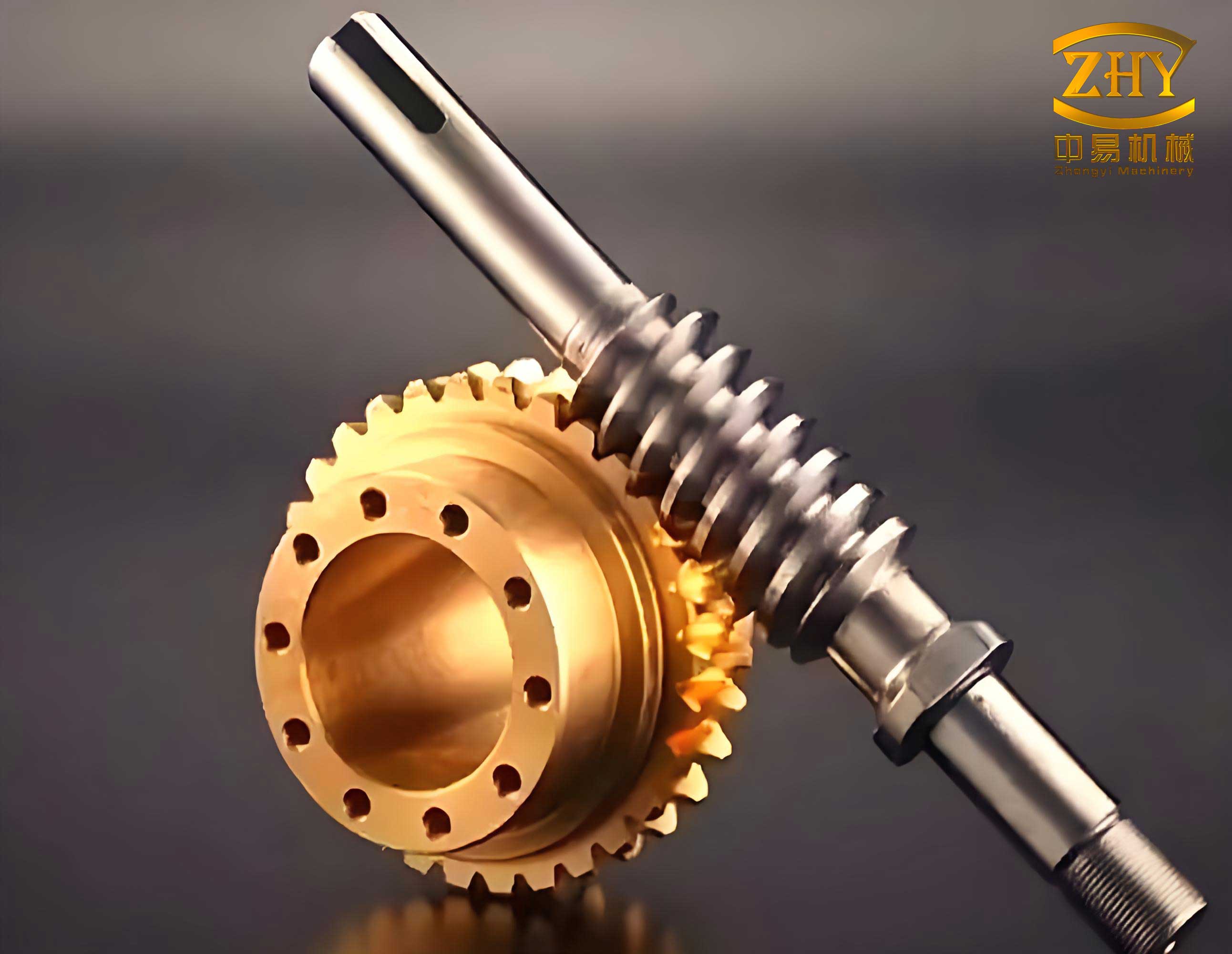
To analyze the lubrication in screw gears, we employ elastohydrodynamic lubrication theory, which considers the elastic deformation of surfaces and the pressure-viscosity effect of the lubricant. For the inclined double-roller enveloping hourglass screw gear drive, the contact between the worm and each roller is equivalent to a line contact between an elastic cylinder and a rigid plane. This equivalence is based on the concept of equivalent curvature radius and equivalent elastic modulus. The line-contact model assumes steady-state conditions, which is a reasonable approximation for analyzing instantaneous contact points along the meshing cycle. The model parameters, such as load, speed, and geometry, vary with position, but we discretize the contact line into points and treat each as a steady-state EHL problem. This approach is widely used in screw gear lubrication studies and provides valuable insights into film thickness distribution.
The mathematical foundation for our analysis relies on the Ree-Eyring fluid model, which describes the non-Newtonian behavior of lubricants under high shear rates. For line-contact TEHL, we use a regression formula derived from numerical solutions to compute the minimum film thickness. The dimensionless parameters involved are defined as follows:
$$H = \frac{h}{R_\sigma}, \quad W = \frac{w}{E’ R_\sigma}, \quad U = \frac{\eta_0 v_{jx}}{E’ R_\sigma}, \quad G = \alpha E’$$
where \(H\) is the dimensionless film thickness, \(h\) is the actual film thickness, \(R_\sigma\) is the equivalent curvature radius, \(W\) is the dimensionless load parameter, \(w\) is the load per unit length, \(E’\) is the equivalent elastic modulus, \(U\) is the dimensionless speed parameter, \(\eta_0\) is the ambient viscosity, \(v_{jx}\) is the entrainment velocity, \(G\) is the dimensionless material parameter, and \(\alpha\) is the pressure-viscosity coefficient. The equivalent elastic modulus is calculated from the properties of the worm and roller materials:
$$\frac{1}{E’} = \frac{1}{2} \left( \frac{1 – \mu_1^2}{E_1} + \frac{1 – \mu_2^2}{E_2} \right)$$
where \(\mu_1, E_1\) and \(\mu_2, E_2\) are the Poisson’s ratios and elastic moduli of the worm and roller, respectively. These parameters are crucial for characterizing the lubrication state in screw gears.
The minimum film thickness for TEHL with Ree-Eyring fluid is given by:
$$H_{\text{min}} = C C_U C_{WS} C_{RS} H_{\text{minso}}$$
$$H_{\text{minso}} = 2.62 U^{0.7125} G^{0.53} W^{-0.16}$$
where \(C\) is a comprehensive correction factor, \(C_U\) is the thermal correction factor related to speed, \(C_{WS}\) is the thermal correction factor related to load, \(C_{RS}\) is the thermal correction factor related to slide-roll ratio and curvature radius, and \(H_{\text{minso}}\) is the minimum film thickness under isothermal conditions. The factors are defined as:
$$C_U = \frac{1}{1 + 2.2 \times 10^4 U^{0.5}}$$
$$C_{WS} = 1 – 1.037 \times 10^4 W^2 + 2.117 \times 10^4 W S$$
$$C_{RS} = e^{-0.041 S – 0.05 (1 + 5 R_z) (\ln R_z + 3)}$$
Here, \(S\) is the slide-roll ratio, and \(R_z\) is the comprehensive curvature radius. This formula applies to steel-on-steel contacts with mineral oil lubricants and slide-roll ratios between 0 and 2, which is typical for screw gears. The actual minimum film thickness is then obtained as:
$$h_{\text{min}} = H_{\text{min}} R_\sigma$$
This equation allows us to compute the film thickness at any contact point along the meshing path of the screw gears.
In screw gears, the equivalent curvature radius \(R_\sigma\) varies along the contact line due to the changing induced normal curvature. For the inclined double-roller enveloping hourglass screw gear drive, \(R_\sigma\) is derived from the meshing geometry. The entrainment velocity \(v_{jx}\) and slide-roll ratio \(S\) are also position-dependent and are calculated based on the kinematic analysis of the gear pair. The entrainment velocity is the average of the surface velocities along the contact normal direction:
$$v_{jx} = \frac{v_\sigma^{(1)} + v_\sigma^{(2)}}{2}$$
where \(v_\sigma^{(1)}\) and \(v_\sigma^{(2)}\) are the projections of the worm and roller velocities along the contact normal. The slide-roll ratio is defined as:
$$S = 2 \times \frac{v_\sigma^{(2)} – v_\sigma^{(1)}}{v_\sigma^{(2)} + v_\sigma^{(1)}}$$
These parameters are essential for evaluating the lubrication performance in screw gears, as they influence the formation of hydrodynamic films.
Load distribution in screw gears is complex due to factors like manufacturing accuracy and alignment. For simplicity, we adopt a simplified method to estimate the load per unit length along the contact line. This involves discretizing the contact line into segments and assigning loads based on the gear geometry and transmitted torque. The table below summarizes the key parameters used in our analysis for a typical screw gear set.
| Parameter | Symbol | Value | Unit |
|---|---|---|---|
| Number of worm threads | \(z_1\) | 1 | – |
| Number of roller teeth | \(z_2\) | 25 | – |
| Center distance | \(A\) | 125 | mm |
| Worm Poisson’s ratio | \(\mu_1\) | 0.26 | – |
| Worm elastic modulus | \(E_1\) | 210 | GPa |
| Roller Poisson’s ratio | \(\mu_2\) | 0.29 | – |
| Roller elastic modulus | \(E_2\) | 207 | GPa |
| Pressure-viscosity coefficient | \(\alpha\) | \(1.6 \times 10^{-8}\) | m²/N |
| Ambient viscosity | \(\eta_0\) | 0.08 | Pa·s |
| Orifice coefficient | \(k_1\) | 0.4 | – |
| Roller radius | \(R\) | 6.5 | mm |
| Roller offset distance | \(c_2\) | 7 | mm |
| Inclined angle | \(\gamma\) | 6 | degrees |
Using these parameters, we analyze the lubrication performance of the screw gears over a full meshing cycle. The contact line is divided into 51 points, corresponding to different angular positions of the worm wheel (\(\phi_2\)). At each point, we compute the equivalent curvature radius, entrainment velocity, slide-roll ratio, and load to determine the minimum film thickness. The results show that both isothermal and thermal minimum film thicknesses vary along the meshing path, with a characteristic dip near the throat region of the worm. This indicates a lubrication danger zone where the film is thinnest, increasing the risk of metal-to-metal contact and wear. The thermal effects reduce the film thickness compared to isothermal conditions due to temperature rise from frictional heating. This underscores the importance of considering thermal aspects in the lubrication analysis of screw gears.
The distribution of minimum film thickness reveals that screw gears with inclined double-roller design exhibit better lubrication performance in areas away from the throat. For instance, near the tip and root regions, the film thickness is larger, providing adequate separation between surfaces. However, the throat region requires attention in design to avoid lubrication failure. To quantify the sensitivity of lubrication to geometric parameters, we vary the roller radius, offset distance, orifice coefficient, and inclined angle while keeping other parameters constant. The impact on TEHL minimum film thickness is evaluated, and the trends are summarized in the following table.
| Parameter | Variation Range | Effect on TEHL Minimum Film Thickness | Implication for Screw Gear Design |
|---|---|---|---|
| Roller radius (\(R\)) | 5 to 10 mm | Decreases with increasing radius, but rate slows | Smaller radii preferred for better lubrication |
| Offset distance (\(c_2\)) | 5 to 9 mm | Increases with offset, especially near throat | Larger offsets improve lubrication |
| Orifice coefficient (\(k_1\)) | 0.3 to 0.5 | Increases significantly with coefficient | Higher coefficients enhance film formation |
| Inclined angle (\(\gamma\)) | 3 to 12 degrees | Minimal change (within 0.3 μm) | Angle has negligible effect on lubrication |
From this analysis, we observe that roller radius and orifice coefficient have the most pronounced influence on lubrication in screw gears. A larger roller radius reduces the film thickness, making it harder to maintain a hydrodynamic film. Conversely, a larger orifice coefficient increases film thickness, promoting better lubrication. The offset distance has a moderate effect, with larger offsets beneficial near the throat region. The inclined angle, however, shows negligible impact, suggesting that it can be chosen based on other design constraints without compromising lubrication. These findings are critical for optimizing screw gear designs to achieve reliable performance.
To further illustrate the mathematical relationships, we derive the induced normal curvature for the screw gears. The equivalent curvature radius \(R_\sigma\) is the inverse of the induced normal curvature \(k_\sigma^{(12)}\):
$$R_\sigma = \frac{1}{k_\sigma^{(12)}}$$
where \(k_\sigma^{(12)}\) is computed from the gear geometry and meshing equations. For screw gears with inclined rollers, this curvature varies along the contact line, affecting the lubrication film. The load per unit length \(w\) is estimated from the transmitted torque and contact length. Assuming uniform load distribution among multiple contact lines, we have:
$$w = \frac{T}{r_b L_c N_c}$$
where \(T\) is the torque, \(r_b\) is the base radius, \(L_c\) is the contact length, and \(N_c\) is the number of simultaneous contact lines. This simplification allows for practical computations in screw gear lubrication analysis.
The entrainment velocity and slide-roll ratio are derived from the kinematic analysis of screw gears. The surface velocities of the worm and roller are computed based on the angular velocities and gear geometry. For a given contact point, the velocity components along the contact normal are:
$$v_\sigma^{(1)} = \omega_1 \times r_1 \cdot \mathbf{n}, \quad v_\sigma^{(2)} = \omega_2 \times r_2 \cdot \mathbf{n}$$
where \(\omega_1\) and \(\omega_2\) are angular velocities, \(r_1\) and \(r_2\) are position vectors, and \(\mathbf{n}\) is the contact normal vector. These calculations are integral to determining the lubrication conditions in screw gears.
In addition to the Ree-Eyring model, we also consider the Dowson-Higginson formula for isothermal EHL, which is commonly used for screw gears. The minimum film thickness for line-contact isothermal EHL is:
$$h_{\text{min}} = 2.65 \frac{(\eta_0 v_{jx})^{0.7} \alpha^{0.54} R_\sigma^{0.43}}{E’^{0.03} w^{0.13}}$$
This formula provides a baseline for comparison with thermal results. However, for screw gears operating under high loads and speeds, thermal effects cannot be ignored, as demonstrated in our analysis.
The lubrication performance of screw gears is also influenced by the lubricant properties. Using Ree-Eyring fluid accounts for shear-thinning, which is prevalent in modern lubricants. The effective viscosity \(\eta_{\text{eff}}\) in Ree-Eyring fluid is given by:
$$\eta_{\text{eff}} = \frac{\tau_0}{\dot{\gamma}} \sinh^{-1}\left( \frac{\eta_0 \dot{\gamma}}{\tau_0} \right)$$
where \(\tau_0\) is the Eyring stress and \(\dot{\gamma}\) is the shear rate. This model better captures the lubricant behavior under the high shear rates encountered in screw gear contacts. Incorporating this into the EHL analysis improves the accuracy of film thickness predictions.
For comprehensive design of screw gears, we recommend using the TEHL analysis framework presented here. By discretizing the contact line and solving for film thickness at each point, designers can identify critical regions and adjust parameters accordingly. The following steps outline the procedure:
- Define the gear geometry and material properties.
- Discretize the contact line into multiple points.
- Compute the equivalent curvature radius, entrainment velocity, slide-roll ratio, and load for each point.
- Calculate the isothermal and thermal minimum film thickness using the Ree-Eyring formula.
- Analyze the sensitivity to geometric parameters and optimize for maximum film thickness.
This approach ensures that screw gears are designed with adequate lubrication, reducing wear and extending service life.
In conclusion, the thermal elastohydrodynamic lubrication analysis of inclined double-roller enveloping hourglass screw gears reveals important insights for improving their performance. We have shown that the minimum film thickness varies along the meshing path, with the throat region being the most critical. The use of Ree-Eyring fluid provides a more realistic model of lubricant behavior, and thermal effects significantly reduce film thickness. Among the geometric parameters, roller radius and orifice coefficient have the largest impact on lubrication, while inclined angle has minimal influence. To maintain good lubrication in screw gears, designers should avoid excessively large roller radii and ensure adequate offset distances and orifice coefficients. This study contributes to the advancement of screw gear technology, promoting efficiency and reliability in power transmission systems. Future work could explore dynamic effects and mixed lubrication regimes in screw gears, further enhancing our understanding of their tribological behavior.